Amazon ads for authors: what $225,000 in ad spend taught me (2026)
For fiction, yes, but not the way most authors expect. Amazon ads are rarely where the sales come from. They are the cheapest way to find out which readers actually want your book, and that information is what makes your Facebook ads pay. For nonfiction, where people search Amazon by topic, they can carry more of the load on their own.
I've managed over $225,000 in ad spend for 350+ authors since 2017, on both Amazon and Meta. Here's what that money taught me about Amazon ads for books, with real numbers from client accounts.
| Metric | Benchmark | What it tells you |
|---|---|---|
| Cost per click, fiction | 70 to 90 cents average | Up from about 20 cents in 2017 |
| Click-through rate | 0.10% or higher | Below this, fix the cover first |
| Conversion rate (sales ÷ clicks) | 5% is good, 10% is excellent | The number that decides everything |
| Clicks before judging a target | 15 | Fewer than that is noise |
| Test budget | $10 a day, 5 to 10 categories | Budget sets speed, not what you learn |
How Amazon ads for books work
Amazon gives authors three ad products: Sponsored Products, Sponsored Brands, and Lockscreen ads. Every time I've tried the second two, they've underperformed. Ignore them. Everything in this guide is about Sponsored Products, which put your book on search result pages and on other books' product pages.
The decision that matters isn't which ad product to use. It's how you target.
Automatic targeting. Amazon takes what it knows about your book and shows it on searches and product pages it thinks will perform. Low effort, decent for a baseline.
Manual targeting, which splits in two:
- Keywords. You bid on what shoppers type into the Amazon search bar: "post apocalyptic fiction," "clean romance," "space opera." When someone searches that phrase, you compete with other authors for the ad slot.
- Products and categories. You bid to appear on the product pages of specific books, or on every book page inside a category. One category target covers the whole shelf.
Most guides tell you to start with keywords. I'll explain below why I start with categories.
Are Amazon ads worth it for books?
Worth it for what? That's the real question.
If you expect Amazon ads to be your main sales engine for a novel, you'll probably be disappointed. Across fiction accounts I've run, Facebook is where the majority of sales come from. Amazon ads on their own rarely cover their cost on a standalone book.
If you treat Amazon ads as a research budget, they're the best money you'll spend. Here's why: Amazon ads show you how real shoppers, already on Amazon with a credit card on file, respond to your cover, your blurb, and your positioning. No other channel gives you that data as cleanly or as cheaply.
A recent example. A client with a post-apocalyptic sci-fi series had Facebook ads that were selling books, but not efficiently, and we weren't sure which angle to lead with. So we ran a six-week Amazon test across keywords, categories, and automatic targeting. Roughly 300,000 impressions, 310 clicks, 2 purchases, and about 1,400 Kindle Unlimited page reads. Terrible as a sales campaign. But the post-apocalyptic angle won on both keywords and categories, while the teen, YA, and first-contact targets went nowhere. That told us the book was being positioned partly at the wrong reader. We're now rewriting the blurb, redoing the second book's cover, and rebuilding the Facebook campaign around the adult post-apocalyptic angle.
That's what Amazon ads are worth: a few hundred dollars for an answer that reshapes everything else.
How much do Amazon ads cost for books
Two numbers set your cost: your daily budget and your bid per click.
Cost per click. When I started running Amazon ads in 2017, you could get clicks for around 20 cents. Those days are gone. On fiction accounts today I see an average of 70 to 90 cents per click, and it climbs with how competitive the target is, because you're bidding against every other author who wants that placement.
Nonfiction in crowded business categories is a different world. On one business book, US keyword bids had to go past $5 a click to get any traffic at all. One placement on a well-known sales book pulled 47 clicks and 2 sales, which is a fine conversion rate, but at $5.56 a click that's over $130 per sale. We turned the US campaign off and kept a small UK campaign running where clicks were under £1.
Daily budget. Authors ask me how much to spend, and my answer surprises them: it doesn't matter much. You'll get the same data whether you spend $5 a day or $30 a day. The budget only decides how fast you get it. I recommend $10 a day for a test.
What a good click looks like. You get cheaper clicks when your ad resonates with the audience. The signal is click-through rate: clicks divided by impressions. Above 0.10%, or one click per thousand impressions, you're in good shape. Below that, the problem is usually your cover, and no bidding strategy fixes a cover.
How to set up Amazon ads for your book, step by step
Authors often call these KDP ads because you reach the console through your KDP account, but the platform is Amazon Ads and it works the same for Kindle books, paperbacks, and hardcovers. This is the exact setup I use for a first test, whether I'm coaching an author through it or running it inside a done-for-you engagement.
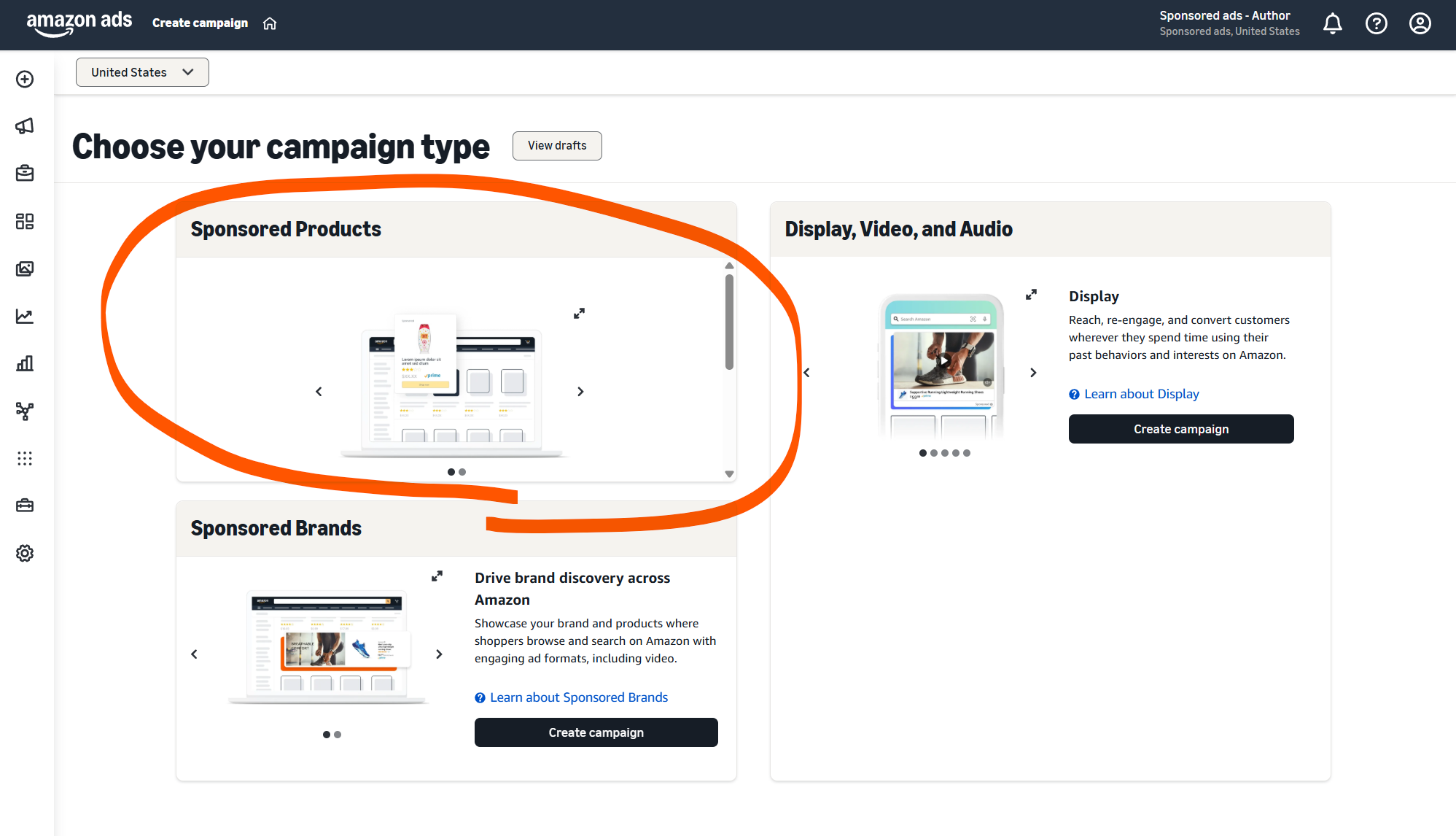
- Go to advertising.amazon.com and sign in with your KDP account. Choose your marketplace (start with the US unless your readers are elsewhere).
- Create a Sponsored Products campaign. Set it to run with no end date. You'll turn it off manually.
- Set the daily budget to $10.
- Choose manual targeting, then product targeting, then categories. Pick 5 to 10 categories your book could plausibly live in. Include a couple you're not sure about. That's the point of the test.
- Set bids to dynamic, up and down. This lets Amazon raise your bid when a click is more likely to convert and lower it when it isn't.
- For each category, bid at the upper end of Amazon's suggested range. Don't go past it. You want enough traffic to read results, not a bidding war.
- Check in every two or three days. Not every two weeks. Runaway targets can rack up 30, 40, 50 clicks with no sale before you notice.
- Give each target 15 clicks before you judge it. Fewer than that and you're reading noise.
Once categories have told you what your book is, you can add a keyword campaign built around that language, and an automatic campaign as a baseline.
Tell me what you've got: your categories, your bids, and what your first 15 clicks are saying. I'll tell you what I'd change before you spend more.
Why category ads beat keyword ads for testing
Keyword testing is expensive because keywords are many. A proper keyword campaign has dozens of phrases, and I want 15 clicks on each target before I trust it. Dozens of targets times 15 clicks times 80 cents is a lot of money to spend before you learn anything. And that's if you're watching closely. Check in every couple of weeks and a few runaway keywords will burn through your budget with nothing to show.
Categories flip that. One category target puts your ad on every book page inside that category, so 5 to 10 targets cover the market. Fewer targets means each one reaches 15 clicks faster, and the data is cleaner because a category represents a whole shelf of reader intent, not one phrasing of it. Amazon's cleanup a few years ago, trimming books to three categories each, made this better: categories are tighter now, so a win in one means something.
Here's the payoff. Years ago, before Amazon Attribution links existed, I had a client whose Facebook ads were selling but we couldn't tell which audience was buying. We ran a category test on Amazon. The clear winner was Christian fantasy, which was not the angle the ads had been using. We put "your next favorite Christian fantasy book" in the Facebook headline and the conversion rate jumped, which brought the cost per new reader down with it. The Amazon test cost a fraction of what the Facebook campaign spent, and it fixed the Facebook campaign.
That's the loop. Amazon tells you the language. Facebook uses it to sell.
Reading your results: the two numbers that matter
Your Amazon ads dashboard shows a lot of columns. Two of them run the show.
1. Click-through rate (clicks ÷ impressions). Target: 0.10% or higher. Below that, shoppers are seeing your book and not clicking, which almost always points at the cover. Reviews and price can play a role, but check the cover first.
2. Conversion rate (sales ÷ clicks). This is the number I care about most. Ten percent is the golden ratio: one sale in every ten clicks. Few books get there. Five percent is good. And here's the part most guides miss: the absolute number matters less than the comparison across your targets. Whichever categories convert highest are telling you what your book is. Double down on those, and then make sure your cover, blurb, look-inside sample, and reviews all say the same thing. Everything about the listing should scream one category, one promise, one reason this book is different.
One more wrinkle for Kindle Unlimited books: the purchases column is only half the scoreboard. Page reads are sales too, and Amazon reports them as KENP read. Divide KENP by your book's KENPC, the page count Amazon assigns it, and you get full-read equivalents to add to your purchases.
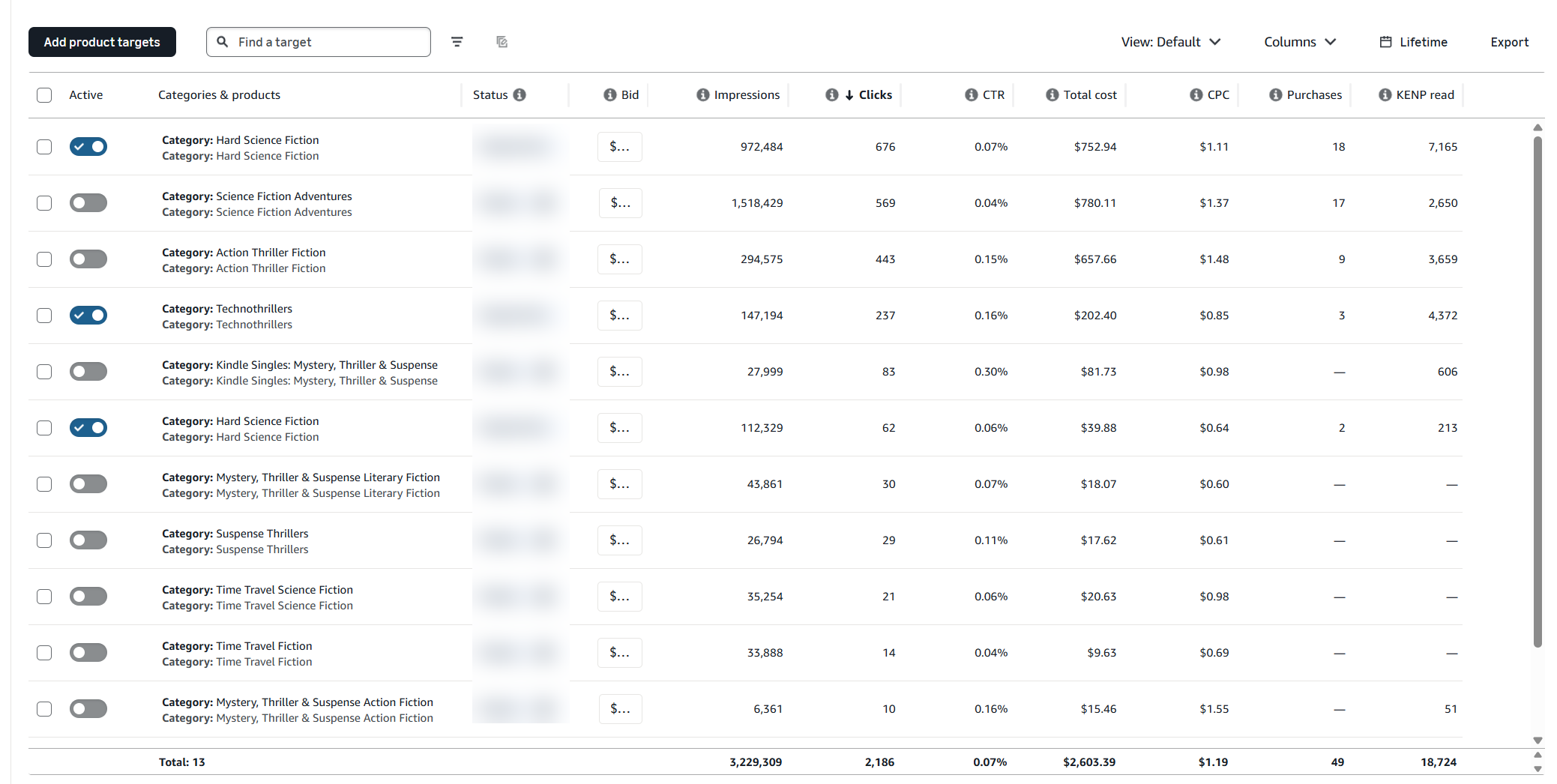
Here's the real table for a sci-fi thriller I run: lifetime data, thirteen category targets. The purchases column says 49. Add the page reads (18,724 KENP at a KENPC of 582 is about 32 full reads) and the real number is closer to 81. Now run the flow on the two leaders. Hard Science Fiction: 18 purchases plus about 12 full reads on 676 clicks is a 4.5% conversion rate, but a 0.07% click-through rate, below the floor. Technothrillers: 3 purchases plus about 7 full reads on 237 clicks is 4.4%, with a 0.16% click-through rate and 85-cent clicks. Same conversion. But one audience clicks the cover and the other scrolls past. Technothrillers is what this book is, and that's the angle the blurb, the cover, and the Facebook campaign get built around.
If a target has 15 clicks and no sale, turn it off. Don't wait for it to come around.
Send me a screenshot of your targeting table and your book's KENPC. I'll tell you which targets are winning, which are lying to you, and what I'd do next.
Amazon ads vs Facebook ads for books
They do different jobs, and for fiction they work best together.
Facebook reaches readers who weren't looking for a book, so it can scale in a way Amazon search never will. It's also where the demographic data lives: on the sci-fi series above, Facebook told us the best-converting audience was men over 55, something Amazon will never tell you. When the same client ran Facebook ads in June, royalties were roughly ten times what the Amazon-only month that followed produced.
Amazon reaches shoppers who are already on Amazon, already browsing books, already primed to buy. Conversion rates are higher, volume is lower, and the data is cleaner. It's the recce mission: cheap, honest conversion data before you commit real budget to Facebook.
My sequence for a fiction launch or relaunch: category test on Amazon first, fix the positioning based on what converts, then scale on Facebook using the language that won. For more on the Facebook side, see Facebook ads for sci-fi novels and the cornerstone piece on cost per new reader vs. value per new reader.
When to run them yourself vs hire it out
Amazon ads are learnable. If you have the time to check in every couple of days and the patience to wait for 15 clicks before reacting, you can run the category test yourself with this guide. This exact system, category tests included, is what I teach inside The Readership Engine, my six-month coaching program: weekly live sessions, open office hours, and someone reviewing your numbers with you. It's $2,497.
Hiring it out makes sense when you have the resources and don't want to be bothered with it. Most of my done-for-you clients are authors with a business or career that pays better than ad management does, and they'd rather spend the hours writing. Amazon ads are part of what done-for-you covers, alongside the Facebook campaign. It starts at $4,000. If you're weighing the two, how much does book marketing cost lays out the full picture.
Either way, the numbers above don't change. Same targets, same thresholds, same loop.
Frequently asked questions
Are Amazon ads worth it for books?
Yes, if you use them for what they're good at. For fiction, Amazon ads are the cheapest way to learn which readers want your book, and that data makes your Facebook ads far more efficient. As a standalone sales channel for a novel, they rarely pay for themselves. For nonfiction with strong topic search, they can do more of the selling on their own.
How much do Amazon ads cost for books?
Clicks on fiction average 70 to 90 cents in 2026, up from around 20 cents in 2017. Competitive nonfiction categories can run past $5 a click. A useful category test costs about $10 a day for two to three weeks, so budget $150 to $250 to get real answers.
How do Amazon ads for books work?
You create a Sponsored Products campaign and choose targeting: automatic (Amazon decides), keywords (search phrases), or products and categories (specific book pages or whole category shelves). You pay per click, and you compete with other authors for placement. Two metrics tell you if it's working: click-through rate above 0.10%, and conversion rate, where 5% is good and 10% is excellent.
What is the best way to advertise my book on Amazon?
Start with a manual category campaign at $10 a day, 5 to 10 categories, dynamic bids up and down, bidding at the top of Amazon's suggested range. Give each category 15 clicks, keep what converts, cut what doesn't, then build your keyword campaign and your Facebook ads around the winning angle.
Do Amazon ads for authors work differently than for publishers?
Same platform, same math. The difference is usually scale: publishers can afford to test more targets at once. An author with one book and $10 a day can learn the same things, it just takes a little longer.
Related reading: how the Facebook campaign gets built, setting up Amazon Attribution links, and whether your book belongs in KDP Select.
Get In Touch
Stuck on your
Amazon ads? Show
me your numbers.
Tell me about your book: genre, how many titles you have, and what your campaigns are doing. I'll tell you honestly what I'd change, and whether it's worth changing at all. If ads aren't the answer yet, I'll tell you that too.
I typically respond within one business day.
Or email directly
[email protected]