I'll tell you which of your books to push, which to fix, and which to stop paying for.
Connect your ad accounts, give me a few days with the numbers, and get ninety minutes of straight answers: where the money should go, and where you're getting the most new readers per dollar.
You're not short on data. You're short on a next move.
No KDP password. No twelve-month contract.
If it's not a fit, I'll say so on the call.
Who this is for
Short version: you've got more than one book to sell, and you're the one deciding where the money goes.
- You run a small press or imprint with a shelf of titles
- You're an agency juggling several authors' books at once
- You write under a few pen names and run it like a business
- You own the ad budget and have to decide which books get it
- You've got one book and you're still finding your feet
- You want someone to start running ads tomorrow without looking at the numbers first
- You've already got a numbers person and just want cheaper software
If it's you and your first book, start on the homepage. That's the right help for where you are. This page is for people with a whole shelf to sell.
Plenty of numbers. No next move.
Book Report, Publisher Champ, PublishWide are good tools. Keep using them. They'll show you sales, page reads, sometimes ad spend.
But a chart isn't a decision. Here's the question none of them answer:
With these books, this month, what's actually worth doing, and which ones should I stop spending on?
It usually shows up one of three ways:
- Facebook's dashboard and your KDP reports tell two different stories, and neither one counts the readers who saw the ad and bought without ever clicking it. If attribution isn't set up properly, you're guessing.
- You keep spending on a series where readers quit after book one, and calling it a traffic problem when it's a book-two problem.
- Nobody's made the call on the backlist. Which titles to push, which to fix, which to stop feeding.
Underneath most of it is read-through, meaning how many book-one readers carry on to book two. Around 50 to 60% on paid sales is healthy (Kindlepreneur; Authors Game). Well under that, and the fix is the books, not more ad spend.
Read-through matters because of what it does to the second of the two numbers below, which is the one that decides whether you can afford to grow at all.
Most people can quote their read-through rate. Almost nobody has a monthly habit of acting on it. That habit is what I'm selling.
The two numbers everything comes down to
When you're deciding where the money goes, there are really only two numbers.
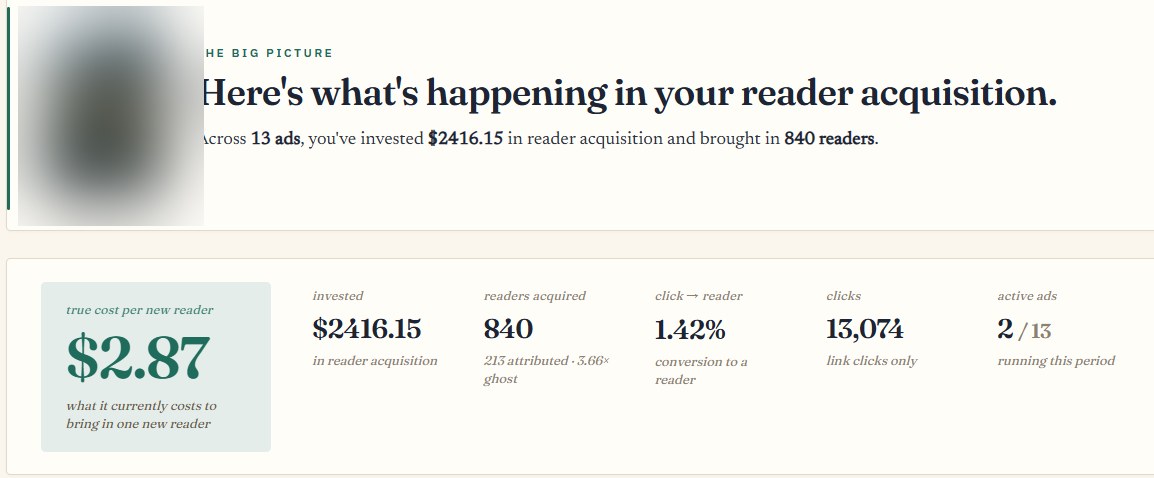
What it costs to get one new reader. Not a click. Not an impression. A person who bought something of yours for the first time.
What that reader is worth once you've got them. Not what they spent on the first book. What they spend across everything they go on to read.
I've published the full breakdown of how I calculate both numbers, formulas and worked example included.
If the second number is comfortably bigger than the first, you can spend more and grow. If it isn't, every ad dollar makes the hole deeper, and better targeting won't save it.
Almost everyone works on the cost side. Better creative, tighter targeting, cheaper clicks. That's real work, and it has a floor, because there's only so cheap a reader can get.
The value side has no ceiling, and almost nobody works on it. It goes up when readers finish book one and start book two. It goes up when a series is priced so the whole run makes sense rather than just the first book. It goes up when the box set exists, when the reading order is obvious, when a dead series stops eating the promo slot a live one should have.
And it's a number about everything you're selling at once, not about any one book. Forty titles means a reader has forty chances to be worth something. That's the advantage you have over an author with four books, and most presses never collect on it.
Get those two numbers far enough apart in your favour and you can outbid anyone for the same reader and still make money. That's the whole game.
Here's the near-term version. Say you're putting $3,000 a month into ads across fifteen titles, and a third of it is feeding a series where readers quit after book one. That's $1,000 a month walking out the door, and it keeps walking until somebody looks. Most of the time the first thing I find pays for the check several times over. Sometimes everything's running tight, in which case I'll say so and you'll have spent a small amount to stop wondering.
What I actually do: a human eye on your numbers
What you're buying on this page is judgment, not software. Someone who reads all of your books together, sales and page reads and ad spend and attribution in one place, and hands you a short ranked list of what to do next. Which books to push. Which to fix. Which to stop paying for.
Two things make that read worth paying for.
I'm inside a lot of accounts. Dozens of author ad accounts, right now, today. When Meta changes something, and lately that's weekly, I watch it land across all of them at once. So you get what I'm learning everywhere, not just what's visible inside your own account. One press with one ad account can't see that pattern. Neither can someone who read about the change in a newsletter.
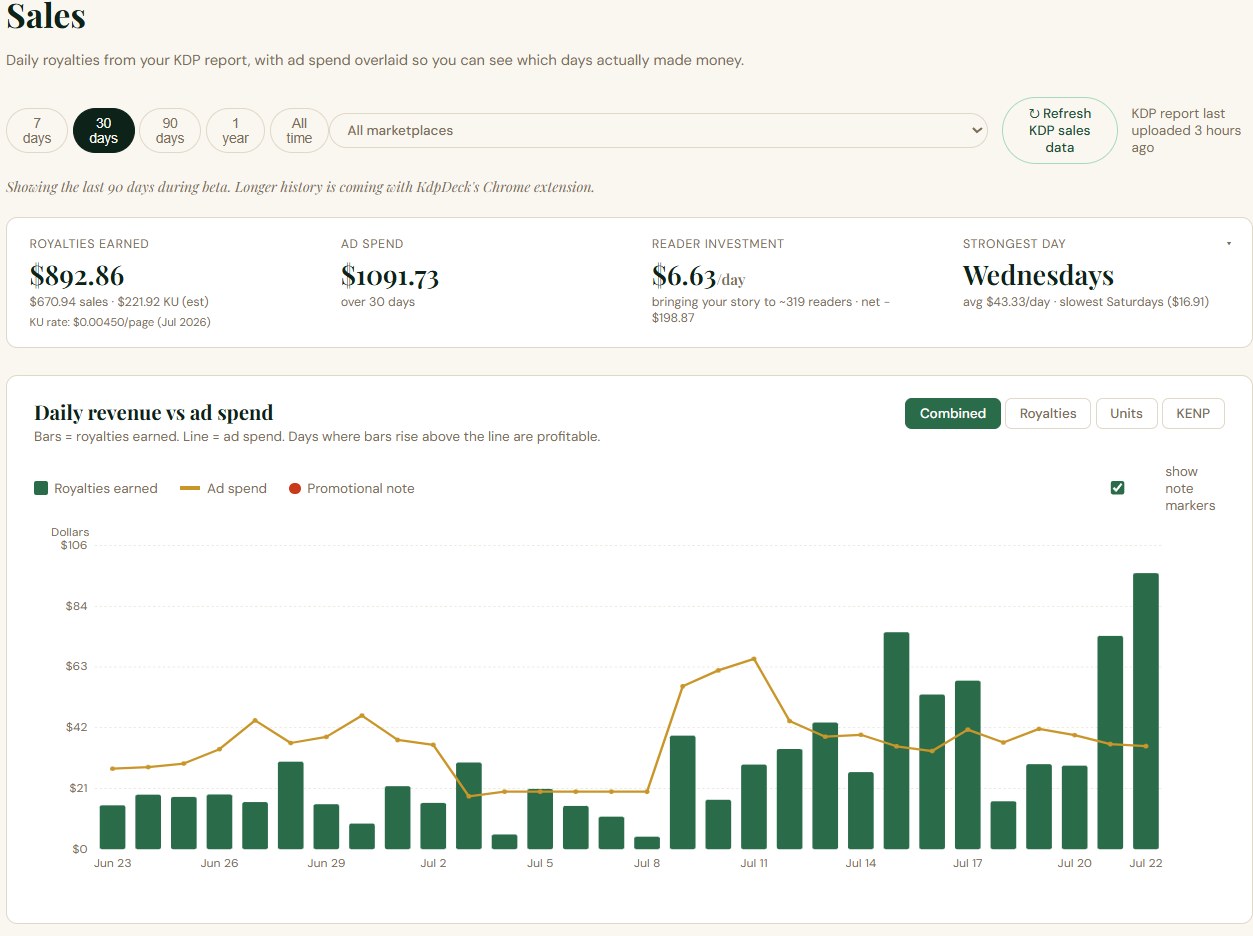
The tooling serves the judgment, not the other way round. I run your numbers through KdpDeck, software I built and now also sell on its own: royalties and ad spend on one line, cost per new reader, read-through by series. But the dashboard is just how I look. The deliverable is what I see, and what I'd do about it. If you'd rather read the numbers yourself, KdpDeck is here.
What you get
A written scorecard, yours to keep. One page at the front with every title marked push, fix, leave alone, or stop paying for, then the detail behind each call. Five ranked moves for the next ninety days, each one with a name next to it so it's clear who's doing what.
Then ninety minutes live to walk through it and argue with me about any of it.
Then fourteen days to email me follow-up questions as your team starts running the moves.
It's a PDF, or a Notion page you own outright if you'd rather work in there. Either way you can forward it to your publisher, your board, or your client without editing anything first.
Ways to work together
1. The Diagnostic
$750–$1,500Depending on how many books you're running. First-timer rate: $497–$750.
One time, fixed price, no contract. You connect your ad accounts, I take about ten business days with the numbers, and we spend ninety minutes on a call going through what's working, what's losing money, and the moves worth making over the next ninety days. See exactly what's included →
2. Monthly Scorecard
$1,500–$2,000/moOnly if the Diagnostic turns up something real. One scorecard and a short list of decisions every month, plus a 45-minute call. You keep running the day-to-day, I keep watching the numbers, including everything Meta changed since last month. Ninety-day trial first, then month to month. Cancel whenever.
3. Ongoing
$2,500–$3,500/moThe monthly scorecard, plus deeper dives into your series and a heads-up before launches. I only quote this after a pilot's gone well. Never as a first ask.
4. White-label packs for agencies
on requestClient-ready one-pagers built from real numbers, with your logo on them. One clear page for the monthly client call instead of a pile of screenshots. Ask once you've seen a sample.
5. Series deep dive
$1,200–$2,500One series, all the way down: where read-through breaks, whether the pricing's right, KU versus wide, and whether a weak book is a traffic problem or a book problem. Lately that often includes testing ads to the Amazon series page instead of the book page, one of the read-through plays I'm running with authors right now. On its own, or folded into the monthly.
How I get your numbers
About five minutes of your time.
I send you a link to connect your Facebook ad account, and you grant me access to your Amazon Ads. That's the whole ask. Standard advertiser access, the same kind you'd give any agency, and you can revoke it any time from your own settings without asking me. I never touch your KDP password or anything to do with your banking. Amazon itself says KDP will never ask for your password by email, and neither will I (KDP account security; how I handle your data).
About ten business days with the numbers. Every book at a glance, the series math, attribution, and a call on each title.
Ninety minutes. What's working, what's losing money, and the specific moves I'd make next. Things I've watched work on other accounts this quarter, not theory. You leave with real decisions and who owns each one.
Want the full read? Sales and page reads live in KDP, not in the ad platforms. Send your KDP sales and page-read exports along too and I can do read-through by series and royalties per book. Exports only, I never need your login. Happy to sign an NDA first.
Proof, not promises
I came up through Air Force logistics and 911 dispatch, so I stay calm with a spreadsheet and a deadline.
I've been working this way for a while. Back in 2023 I spent an episode of the Hidden Gems podcast on cost versus value of a new reader, which is the same pair of numbers this whole page is built on. It isn't a framework I invented for a sales pitch.
I'm still building named press and agency case studies through paid work, so until there are logos on this page, go look at a real anonymized scorecard and the dashboards behind it. Five minutes and you'll know whether this is how you think.
Questions I get
How is this different from Book Report or Publisher Champ?
Keep your tracker, I'm not competing with it. Those tools show you the numbers. I put a human eye on them and tell you what to do: a short ranked list, what each move is likely worth, and who should own it. If your monthly review already ends with five clear moves that everyone actually runs with, you don't need me.
How do you keep up when Meta changes things every week?
By seeing it everywhere at once. I'm inside dozens of author ad accounts, so when Meta shifts something I watch it hit all of them, and I bring you what's already working elsewhere rather than what worked last year.
Do you run my Facebook or Amazon ads?
Yes, but not until I've looked at your numbers. I'm not going to take your money to scale something that's leaking, and I can't tell whether it's leaking until I've seen it. So the check comes first. If the ads turn out to be the problem, I'll say so and we can talk about me running them. If the books are the problem, more spend was never going to fix it, and you'll be glad you found that out for a four-figure sum instead of a five-figure one.
Will you need my KDP password?
Never. You connect Facebook through a link and grant me access on the Amazon Ads side. No passwords change hands, and you can pull the access whenever you like. For the deeper read, KDP exports cover the rest.
Once you tell me what to fix, who fixes it?
You do, or your team does. I hand you the moves and the reasoning, not an invoice for doing them. If a move needs more than your team can take on, I'll say so on the call rather than letting you find out in three weeks.
What kind of books do you work with?
Genre fiction with real series math is my home turf. Sci-fi and fantasy especially, but romance, thrillers, and anything series-heavy translates fine. One-off nonfiction isn't a great fit.
Can agencies put their own name on this?
Yes. The one-page briefs are built for client calls. I'm not trying to replace your blurb-and-content work, this sits next to it.
Start here
If working out where to spend keeps landing at the bottom of your to-do list, start with twenty minutes. Tell me what you're selling and I'll tell you straight whether there's money sitting in there or whether you're already running it tight.
If it's not a fit, I'll say so on the call.
How I handle your data · About me · What book marketing costs
Get In Touch
Let's find the money
in your books.
Tell me what you're working with, whether that's a press, an agency, or your own pen names, roughly how many books, and what you're using now. If the hard part is knowing where to spend, twenty minutes on a call is the fastest way to find out.
I usually reply within one business day.
Or email directly
[email protected]