The Diagnostic
A one-time read on everything you're selling. What's working, what's losing money, and the five moves worth making over the next ninety days.
You get a written scorecard you keep, a ninety-minute call to go through it, and two weeks of follow-up questions afterwards.
$750–$1,500 depending on how many books you're running. First-timer rate $497–$750. Larger job, 40 to 100 titles or several pen names: $1,800–$2,500.
If it's not a fit, I'll say so on the call.
Or email me at [email protected] and I'll send scope and price in writing.
Why a read before anything else
Most people arrive wanting someone to run their ads. Fair enough, that's the obvious thing to buy, and I do run ads.
I just won't quote you for it until I've looked at your numbers.
Here's why. If a series is losing readers between book one and book two, more traffic into the top of it makes the problem more expensive, not smaller. I could take your money, run technically excellent campaigns for six months, and you'd end up further behind than when you started. The ad account would look busy the entire time.
I'm not willing to sign a client I can't win for. Looking first is how I avoid it.
So the check comes first, at a small fixed price, and it answers one question: is this an ads problem or a books problem. If it's the ads, I'll say so, and we can talk about me running them. If it's the books, more spend was never going to fix it, and you'll have found that out for four figures instead of five.
And if everything's already running tight and there's nothing much to fix, I'll tell you that too. You'll have paid a small amount to stop wondering, which is worth something on its own.
Two examples of what this looks like
One author had book one permanently free. In a typical month, 194 people downloaded it. Fourteen went on to buy book two. He was paying for Amazon ads to push more people into the top of that, and losing about $60 a month doing it.
Look at it as the two numbers and the problem is obvious. A new reader was worth almost nothing, so any cost at all was too much. No amount of cheaper clicks fixes that. Book one went to $2.99, the series moved into Kindle Unlimited, and the next month ran 660 sales and $1,332 in revenue on $553 of ad spend. A $60 loss turned into a $779 profit.
That change didn't get him cheaper readers. It made the readers worth more.
Another had a series where book one was in the wrong category and the description was written for a different reader than the one buying. Read-through across the series improved sevenfold once that was corrected. Again, not an ads problem.
Both of those are single authors rather than presses, because that's where I've spent the last six years. The maths doesn't change when there are forty titles instead of four. It just gets much harder to spot by hand, which is the entire reason this exists.
What's included
Fixed scope. This is the whole list.
- Everything at a glance. Up to 40 titles across 8 series. Larger than that and it's the bigger job, or we take one imprint at a time.
- Series maths. Read-through book by book, on paid sales and on KU page reads where the data supports it.
- Price and promo map. Where each book sits in its series against what it's priced at, and what your promo history did.
- Category and keyword flags on your top 10 to 15 titles. Not a rebuild of every listing.
- Ad efficiency. Which titles are engines and which are sinks. Recommendations only. I don't touch the campaigns.
- A call on every book reviewed: push, fix, leave alone, or stop paying for.
- Five ranked moves for the next ninety days, each with a name next to it so it's clear who's doing what.
- A ninety-minute call to go through all of it, plus fourteen days of follow-up questions by email.
Not included
- Building, running, or optimising ad campaigns
- Creative, covers, or blurb rewrites as done-for-you work
- Reading manuscripts or editorial work
- Social content or publicity
- Unlimited calls
Ad management isn't part of this job. It's a separate conversation, and one I'm happy to have once I've seen what's actually going on.
What you get at the end
A written scorecard. One page at the front with every title marked, then the detail behind each call, then the five moves.
It's a PDF, or a Notion page you own outright if your team would rather work in there. Either way it's yours to forward to your publisher, your board, or your client without editing it first.
Then ninety minutes live to walk through it and argue with me about any of it. I send it ahead of the call so you've read it on your own time rather than watching me present slides.
Then two weeks to email me questions as your team starts running the moves.
How I look at it
Everything in this comes down to two numbers, and they're the two I build the whole read around.
What it costs you to get one new reader. Not a click, not an impression. A person who bought something of yours for the first time.
What that reader is worth once you've got them. Not the first book. Everything they go on to read.
If you want the working shown, I've written the full breakdown of how I calculate both numbers.
The gap between those two decides whether you can afford to grow. Almost everyone spends their effort on the cost side, chasing cheaper clicks, and the cost side has a floor. The value side has no ceiling and almost nobody works on it, even though it's the side you control. Read-through, pricing across a series, reading order, box sets, which series gets the promo slot. All of it moves the second number.
It's also a number about everything you're selling at once rather than any single book, which is why it's worth more to you than to an author with four titles. More books means more chances for a reader to be worth something. Most presses never collect on that.
So the read isn't "are your ads working." It's whether the gap between those two numbers is wide enough to scale into, and if it isn't, which lever closes it fastest.
I run your numbers through KdpDeck, software I built for this work. Royalties and ad spend on one line, cost per new reader, read-through by series. It's how I look, not what you're buying here. You can subscribe to it separately if you'd rather do your own reading, but the Diagnostic is me doing it for you.
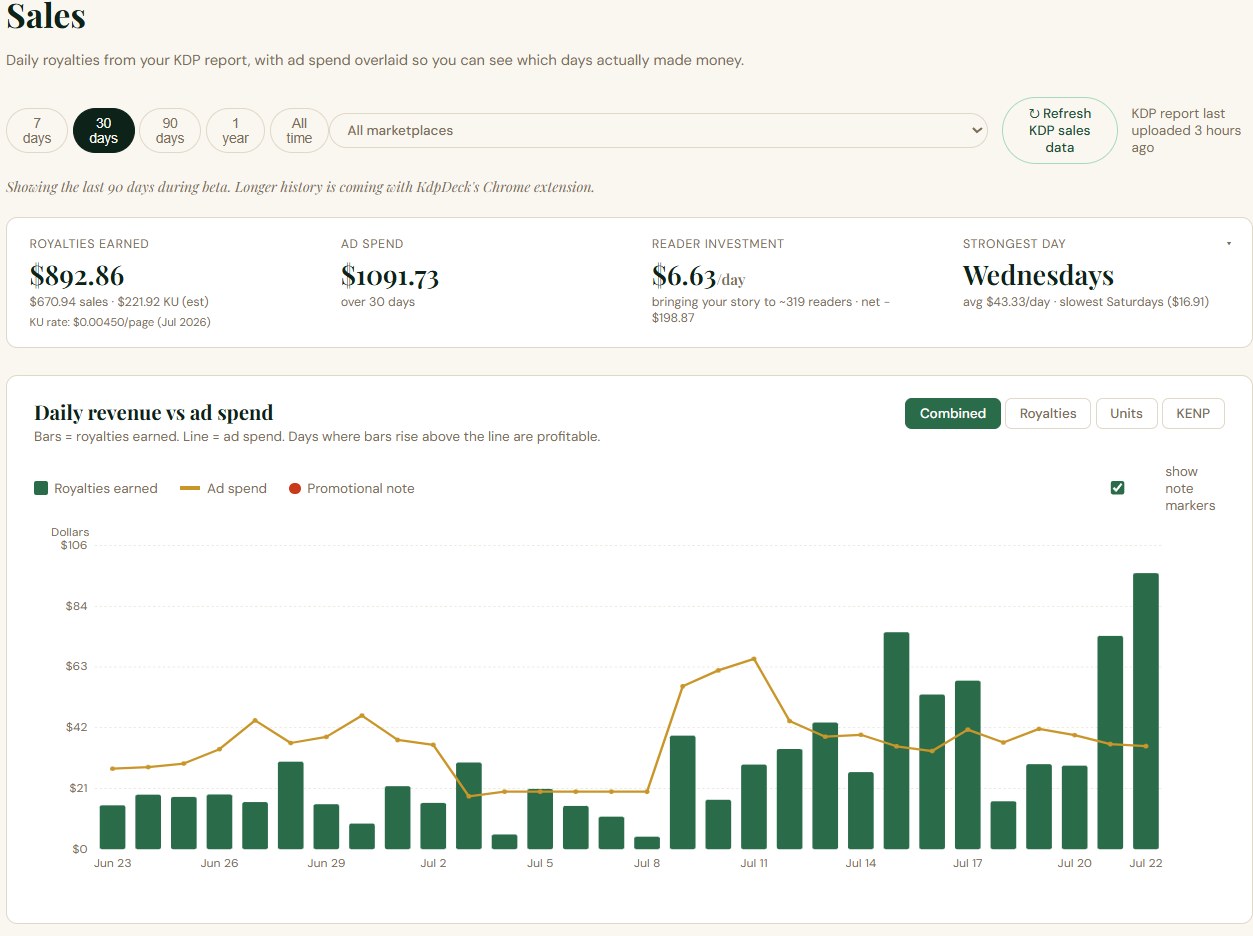
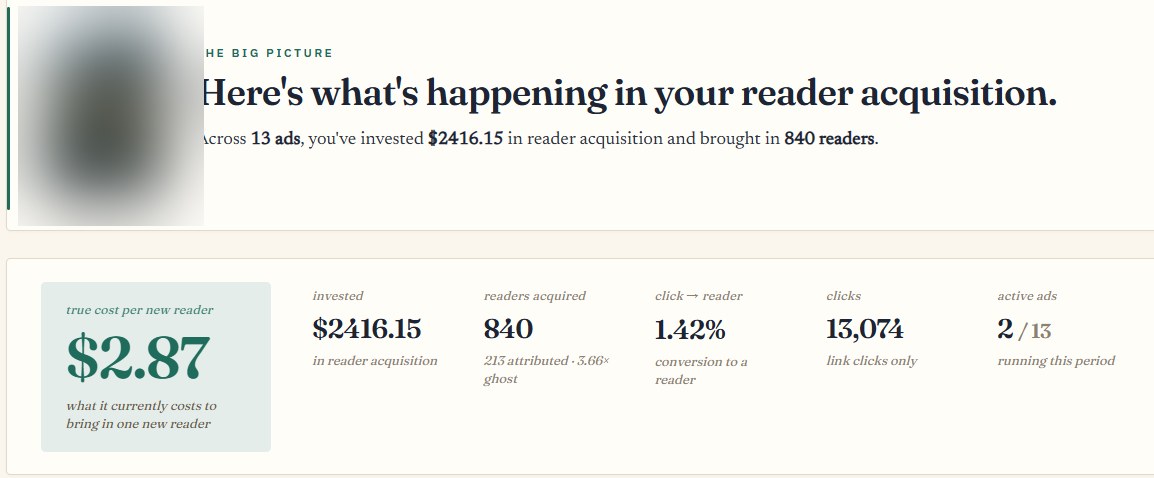
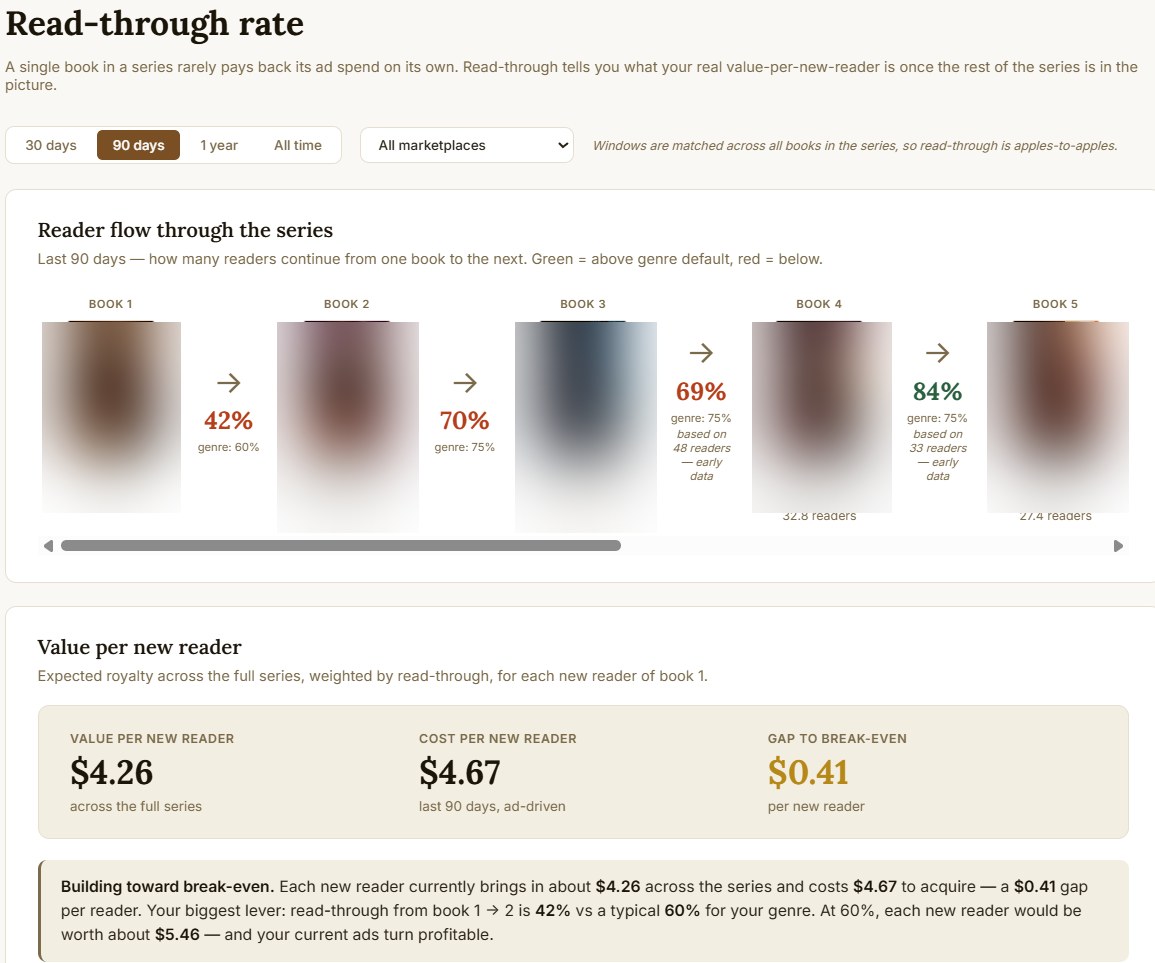
One more thing that doesn't show up in a dashboard. I'm inside dozens of author ad accounts at any given time, so I know what's working across all of them this month rather than what worked last year. Which audiences are actually converting right now, which creative styles are pulling and which have gone stale. You can't get that from your own account, however good your reporting is. It goes into every read I do.
What I need from you
About five minutes of your time.
Ad accounts. You send me a link to connect your Facebook ad account and grant me access on the Amazon Ads side. Standard advertiser access, the same kind you'd give any agency, and you can revoke it yourself at any time without asking me.
Sales and page reads. These live in KDP, not in the ad platforms, so I need exports. Last 90 to 180 days of your sales and KENP reports covers it. A spreadsheet of your series and current prices helps too.
Never. Your KDP password, your banking, or 2FA codes. Amazon's own guidance says KDP will never ask for your password by email, and neither will I (KDP account security).
If you'd rather not connect anything until there's an NDA in place, say so and I'll send one first. If you'd rather screen-share and click through it yourself while I take notes, that works too, it just takes longer.
More detail: how I handle your data.
Timeline
| Twenty-minute call | Before anything is paid |
|---|---|
| You connect, I get the exports | Day 0 |
| I'm in the numbers | About 10 business days |
| Written scorecard sent | Before the call |
| Ninety-minute walkthrough | Live |
| Follow-up questions | 14 days after |
Invoiced up front, due before I start. No contract beyond the job itself.
Price
| First-timer rate, in exchange for a case study and honest feedback | $497–$750 |
|---|---|
| Standard, up to 40 titles across 8 series | $750–$1,500 |
| Larger job: 40 to 100 titles, or three or more pen names | $1,800–$2,500 |
Published on purpose. If someone won't tell you scope and price before a call, assume the number is large (what book marketing usually costs).
Questions I get
We already use Book Report and a spreadsheet. Why pay for this?
If your monthly review already ends with five clear moves that people actually run, you don't need it. Most teams have plenty of charts and still pick promos out of habit. What you're buying is the call on each book, not another view of the same numbers.
What if you don't find anything?
Then I'll tell you that, and you'll have a written record showing your spending holds up, which is a reasonable thing to have. I'd rather say that than invent a problem to justify the invoice. It's also the honest reason I don't lead with a monthly retainer: I don't know yet whether you need one.
Do you run ads?
Yes, but not as part of this and not before I've looked. Once the check is done I'll tell you straight whether ads are where your problem is. If they are, we can talk about me running them, and I'll be quoting on a job I already understand instead of guessing.
Will you need my KDP password?
Never. Connect on the ad side, exports for the sales data, and you can pull access whenever you like.
Can you work from public Amazon data only?
For a rough sample, yes. For the real thing, no. Royalties, page reads, and actual spend aren't public, and those are the numbers that decide anything.
What's a good read-through rate?
It depends on whether you're paid, KU, or running book one free, so there's no single number. Around 50 to 60% book one to book two on paid sales is a common planning floor before scaling ads hard (Kindlepreneur; Authors Game). I work out your actual rates on your window and read them against your own pricing rather than against a benchmark from a blog post.
Do you work with agencies?
Yes. Usually on one flagship client's books first, or as white-label performance packs afterwards.
What happens after?
One of three things. If there's enough to act on every month, I'll offer a ninety-day Monthly Scorecard pilot at $1,500/mo, and I'll do it on the call rather than emailing you a proposal a week later. If the ads are the bottleneck, we talk about me running them. If neither applies, you keep the plan and we leave it there. Nothing gets sold cold, and nothing arrives in your inbox that we haven't already discussed out loud.
Start here
Twenty minutes. Tell me roughly how many books you're running and what the headache is, and I'll tell you whether there's likely something worth finding.
If it's not a fit, I'll say so on the call.
Or email [email protected] and I'll send scope and price in writing. Prefer to see the format first? Here's what the work looks like.
Get In Touch
Scope and price,
in writing.
Tell me what you're working with, whether that's a press, an agency, or your own pen names, roughly how many books, and what the headache is. I'll reply with scope, price, a data checklist, and timeline.
I usually reply within one business day.
Or email directly
[email protected]