KDP Select pros and cons: should your book be exclusive to Amazon?
KDP Select makes your ebook exclusive to Amazon for 90 days in exchange for Kindle Unlimited exposure, per-page payments, and promo tools. If you write fiction, enroll: in most fiction categories 70 to 80%+ of books are already in KU and readers expect yours there. If you write nonfiction, think twice: KU penetration is often just 20 to 30%. A full KU read of an 80,000-word novel pays about $1.56 vs roughly $2.69 for a $3.99 sale, but most KU readers would never have bought the book, so the real comparison is often $1.56 versus nothing.
You published your book on Amazon. Then a little checkbox asked if you want to enroll in KDP Select.
One checkbox. It changes where you can sell your ebook, how you get paid, and what marketing tools you have access to.
Here's my short answer: if you write fiction, enroll. If you write nonfiction, think twice. The rest of this article shows you the numbers behind that recommendation so you can check my work.
What is KDP Select?
KDP Select is Amazon's optional program for self-published ebooks. You agree to sell your ebook only on Amazon for 90 days at a time. In return, your book goes into Kindle Unlimited, where subscribers read it for free and you're paid for every page they read, and you get two promotion tools: Kindle Countdown Deals and up to five free days per 90-day term.
It covers your ebook only. Your paperback, hardcover, and audiobook can still be sold anywhere. Enrollment renews automatically every 90 days unless you untick the renewal box in your KDP Bookshelf.
KDP Select vs Kindle Unlimited: same program, two names
These terms get used interchangeably, and it confuses everyone at first.
KDP Select is the program from the author's side. You enroll your ebook.
Kindle Unlimited (or KU) is the same program from the reader's side. Readers pay a monthly subscription, around $11.99 a month in the US as of this writing, and get unlimited access to every book enrolled in the program.
So when a blog says "put your book in KU," they mean enroll in KDP Select. Same thing.
What you're actually agreeing to
When you enroll, you agree that your ebook is exclusive to Amazon for 90 days. That's the whole deal.
Two things people get wrong:
It's ebook only. Your paperback can go anywhere. Barnes and Noble, your website, the trunk of your car. A lot of authors think Select locks up everything. It doesn't. Ebook only.
It's 90 days, not forever. The enrollment period is 90 days. It auto-renews unless you turn that off, but you can exit at the end of any period. You're not signing your book away.
The alternative is called going wide. Wide means your ebook is on Amazon, Apple Books, Google Play, Kobo, Barnes and Noble, all of it.
So the real question is: Select or wide?
The pros of KDP Select
1. Exposure to Kindle Unlimited readers
This is the big one, especially for fiction.
KU readers are heavy readers. They pay a subscription and they use it. When your book is in Select, every one of those readers can pick it up without paying anything extra. No purchase decision. No "is this worth $4.99." They just tap and read.
I've worked with hundreds of authors, and for fiction, the ones in KDP Select usually do better. For many of the authors I work with, half their income comes from Kindle Unlimited page reads. Not a side channel. Half.
There's a second thing I see with KU readers that rarely gets mentioned: read-through is stronger. When a KU reader finishes book one of your series, picking up book two costs them nothing. No new purchase decision. So they keep going. For a series author, that compounds fast.
2. You get paid per page read
When a KU subscriber reads your book, you earn money for every page they read. We'll do the math on this in a minute, because "per page" raises an obvious question: whose page count?
3. Kindle Countdown Deals
Select gives you access to Countdown Deals, which let you run a limited-time discount while keeping your 70% royalty rate. Normally, dropping below $2.99 knocks you down to 35%. A Countdown Deal at $0.99 keeps you at 70%.
That's genuinely useful for price promotions. I'll be honest, the setup can be clunky. The scheduling rules are picky and you can't run one right after changing your price. But it's a good tool once you learn its quirks.
4. Free Book Promotions
Select also gives you 5 free days per 90-day period, where you can give your ebook away.
I'm including this because every article lists it as a pro. My actual recommendation: skip it. Free downloads attract freebie collectors, not readers. Your book gets downloaded a thousand times, read by almost nobody, and you've trained the algorithm on an audience that doesn't buy. There are better ways to use a launch. But the feature exists, so now you know.
5. Simplicity
If you're a newer author, this one matters more than you think.
Marketing a book on one platform is already a lot. Going wide means driving readers to Amazon and Apple and Kobo and Google Play, tracking sales in four dashboards, and learning four sets of promotional tools. It's another layer of complexity at the exact moment you're already overwhelmed.
Select means one store, one dashboard, one strategy. That has value.
The cons of KDP Select
1. Lower earnings per reader
This is the trade at the heart of the decision. Let's do the actual math.
When someone reads your book through Kindle Unlimited, you get paid per page. Not the pages in your Word doc, and not the pages in your PDF. Amazon uses its own page count called KENPC (Kindle Edition Normalized Page Count).
Quick history: when the program started, authors gamed it. Triple spacing, 20-point font, a 200-page book suddenly claiming 1,500 pages. Amazon shut that down by calculating the page count themselves. You don't know your exact KENPC until the book is live, but a rough rule of thumb is about 250 words per page. An 80,000-word novel lands somewhere around 320 to 380 KENPC pages.
Here's what that means in dollars, as of this writing:
| Ebook sale at $3.99 | Full KU read (~380 pages) | |
|---|---|---|
| How you're paid | 70% royalty minus delivery fee | ~half a cent per page |
| You earn | ~$2.69 | ~$1.56 |
The per-page rate moves up and down each month, so treat $1.56 as a snapshot, not a promise. But the shape of it holds: a borrow pays you roughly a dollar less than a sale.
So Select costs you about $1.13 per reader. Sounds bad, right?
Except here's the thing. That comparison assumes the KU reader would have bought your book if it wasn't in Select. Most wouldn't. They pay for a subscription specifically so they don't have to buy books. If your book isn't in KU, you don't convert them to a $2.69 sale. You lose them entirely. $0.
So the real comparison is often $1.56 versus nothing.
One more wrinkle, and it's good news if you write long. Because you're paid per page, big books earn more per read. I work with fantasy authors whose books run well past that 380-page mark, and a full read-through pays close to what a sale would. The per-reader gap that looks scary at 380 pages nearly disappears at 600.
2. You can't sell your ebook anywhere else
For 90 days, your ebook is Amazon only. No Apple Books, no Kobo, no selling from your own website. If building direct sales or reaching non-Amazon markets is part of your plan, Select blocks that for the enrollment period.
3. You're all-in on one platform
Your ebook income depends entirely on Amazon and its algorithm. Amazon changes something, your visibility changes with it. Wide authors spread that risk across stores. That's a legitimate long-term concern. I'd just say it's a concern to grow into, not one to solve in your first 90 days.
The fiction vs nonfiction split
Here's the part most pros-and-cons lists skip, and it's the part that should drive your decision.
Reader expectations are different by genre. In most fiction categories, the majority of books are already in Kindle Unlimited. In most nonfiction categories, they're not.
You can check this yourself in Publisher Rocket (affiliate link). Look up your categories and check the KU percentage:
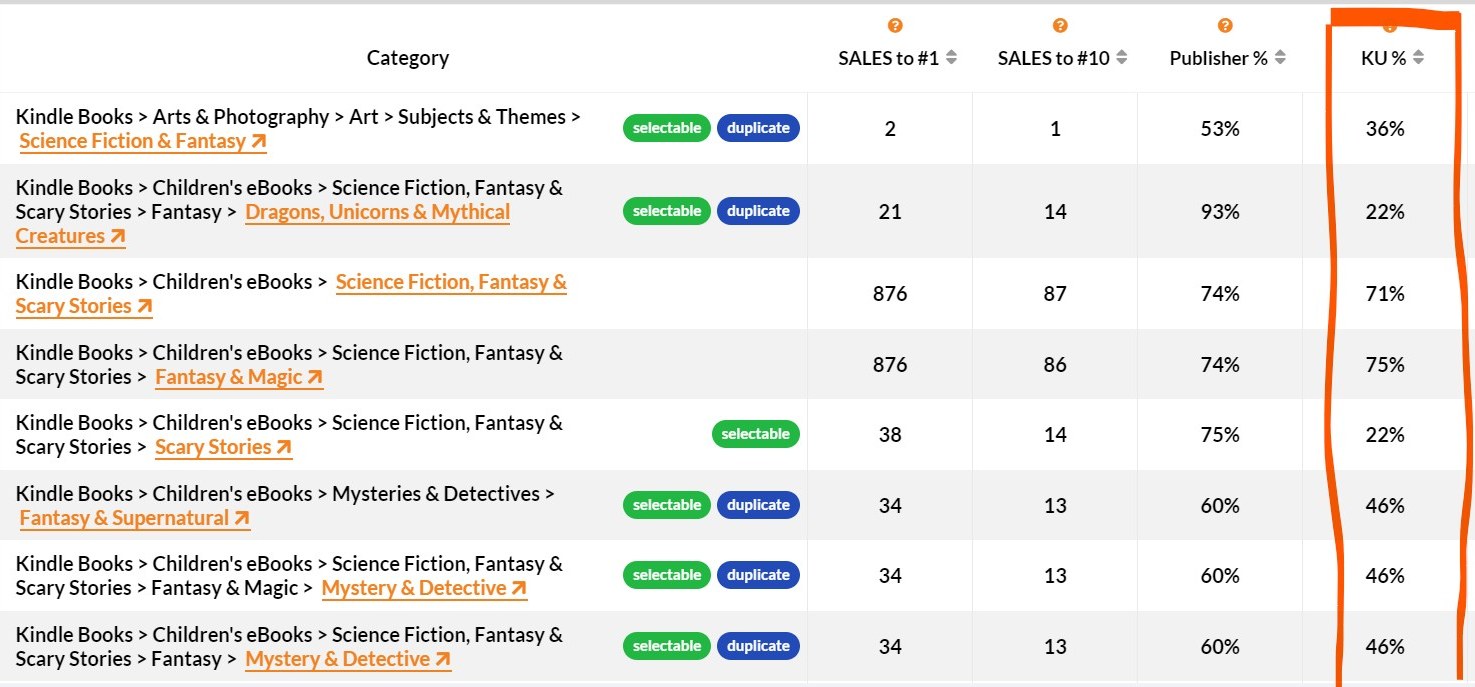
That's the fantasy tree. The two core categories sit at 71% and 75%, and that's in children's ebooks, one of fiction's softer corners. In the adult fiction categories I checked for a recent client it ran higher still: 86%, 84%, and 81% of the books were in Kindle Unlimited. Action-adventure science fiction: 69%. That's typical for fiction. 70 to 80% is common.
Now look at nonfiction:
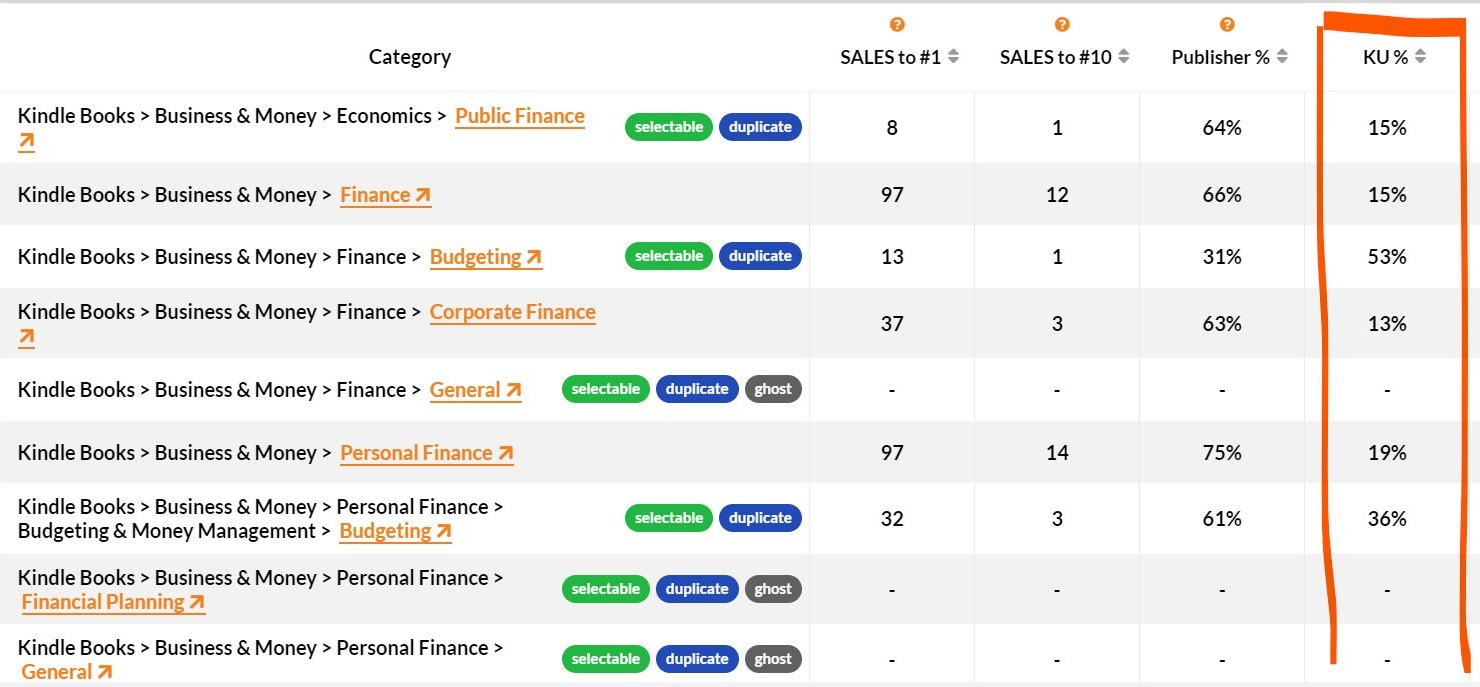
Finance: 15%. Corporate finance: 13%. Personal finance: 19%. Pure mathematics, when I checked it: 26%. Crafts and hobbies, dog training: the same story. Far below any core fiction category.
Why does this matter? Because if you're a fiction author driving readers to your book page, most of them expect to see that Kindle Unlimited logo. A big chunk of them are KU subscribers who mostly read within their subscription. If your book isn't in the program, your conversions drop and those readers move on.
Nonfiction readers buy differently. They're buying a solution to a problem, and far fewer of them are browsing through KU. The exposure benefit shrinks, and the case for going wide gets stronger.
So should you enroll? My recommendation
If you write fiction: enroll. At least for your first 90 days.
The math favors it, reader expectations favor it, and the simplicity favors it. You'll reach KU readers you'd otherwise lose entirely, and you only have one platform to learn while everything is new. And when half of many authors' income comes from page reads, "exposure versus income" turns out to be a false choice. For fiction, the exposure is income. At the end of 90 days, you can look at your actual numbers and decide again. That's the beauty of the term. It's an experiment with a built-in end date.
If you write nonfiction: think twice.
Check your category's KU percentage first. If it's down at 20 or 30%, the exposure argument mostly disappears, and going wide from day one is a reasonable call. If your nonfiction category happens to be KU-heavy, treat it like fiction.
The one thing I'd tell you either way: this is a 90-day decision, not a forever decision. Pick one, run it, look at the data, adjust. The authors who get stuck are the ones who treat it as a permanent identity. "I'm a wide author." "I'm a KU author." You're an author running an experiment. That's it.
And if you're staring at your own numbers after 90 days and can't tell what they're saying, that's the kind of thing I work through with authors in coaching. The data usually has an answer. It just doesn't always announce itself.
Worth reading next: cost per new reader vs value per new reader, the two numbers that decide whether your ads are working, and the free Amazon Attribution setup that shows which ad image actually sells books.
Frequently asked questions
What is KDP Select in simple terms?
KDP Select is Amazon's optional program where you agree to sell your ebook exclusively on Amazon for 90 days. In exchange, your book joins Kindle Unlimited, you get paid for pages read by subscribers, and you unlock promotional tools like Kindle Countdown Deals.
Does KDP Select apply to paperbacks?
No. Exclusivity applies to the ebook only. Your paperback and hardcover can be sold anywhere: Barnes and Noble, bookstores, your own website, anywhere.
How much does KDP Select pay per page?
The rate changes monthly, but as of this writing it's roughly half a cent per page. A full read of an 80,000-word novel (around 380 KENPC pages) pays about $1.56. Compare that to roughly $2.69 for a $3.99 ebook sale at the 70% royalty rate.
What is KENPC?
KENPC stands for Kindle Edition Normalized Page Count. It's Amazon's standardized page count for your ebook, used to calculate Kindle Unlimited payments. Amazon calculates it for you after your book is live. A rough estimate is about 250 words per page.
Is KDP Select worth it for fiction authors?
Usually, yes. In most fiction categories, 70 to 80% or more of books are already in Kindle Unlimited, so readers expect to find your book there. Having worked with hundreds of fiction authors, I regularly see half their income come from Kindle Unlimited page reads, and read-through to the next book in a series is stronger with KU readers.
Do longer books earn more in Kindle Unlimited?
Yes. KU pays per page read, so a longer book earns more per full read-through. For large books like epic fantasy, a complete read can pay close to what a full-price ebook sale would.
Is KDP Select worth it for nonfiction authors?
Often not. Most nonfiction categories have far fewer books in Kindle Unlimited, sometimes 20 to 30%, so the exposure benefit is much smaller. Check your specific category's KU percentage before deciding.
Can I leave KDP Select after 90 days?
Yes. Enrollment lasts 90 days and auto-renews unless you turn off auto-renewal in your KDP dashboard. Turn it off, wait for the period to end, and your ebook is free to go wide.
What's the difference between KDP Select and going wide?
KDP Select means your ebook is exclusive to Amazon. Going wide means your ebook is available across multiple retailers: Amazon, Apple Books, Kobo, Google Play, Barnes and Noble, and others. You can switch between them at the end of any 90-day enrollment period.
Get In Touch
Staring at your
numbers and can't
tell what they say?
Tell me about your book: genre, how many titles you have, and whether you're in KU or wide. I'll give you a straight read on whether your setup matches your goals, and what I'd test next.
I typically respond within one business day.
Or email directly
[email protected]