How many pages in a novel, novella, novelette, and short story?
A novel is 50,000 to 110,000 words, which works out to roughly 200 to 440 printed pages. The average novel is about 90,000 words — 300 to 360 pages at the standard 250–300 words per page. A novella runs 20,000–50,000 words (about 80–200 pages), a novelette 7,500–20,000 words, and a short story anything under 7,500 words. Genre moves these targets a lot: the average bestselling fantasy novel is 109,000 words (~436 pages), while a young adult novel can succeed at half that.
Below is every number you need — by story type, by genre, and by chapter — plus honest advice on how long your first book should be. The figures come from analyzing Amazon's top 100 sellers per genre and from campaign data across the 350+ authors I've worked with.
Word count and page count by story type
Stories are classified by word count, not page count — pages vary with trim size and font, words don't. Here are the generally accepted ranges, with page counts calculated at 250 words per page:
| Story type | Word count | Approx. pages | Example |
|---|---|---|---|
| Flash fiction | 300 – 1,500 | 1 – 6 | — |
| Short story | 1,500 – 7,500 | 6 – 30 | Most magazine fiction |
| Novelette | 7,500 – 20,000 | 30 – 80 | The Call of Cthulhu (~12,000) |
| Novella | 20,000 – 50,000 | 80 – 200 | Animal Farm (29,966); The Metamorphosis (22,009) |
| Novel | 50,000 – 110,000+ | 200 – 440+ | Most commercial fiction |

Boundaries are conventions, not laws. Science fiction and fantasy writers should know the official awards definitions too: SFWA's Nebula Awards (and the Hugos) draw the lines at short story under 7,500 words, novelette 7,500–17,500, novella 17,500–40,000, and novel anything over 40,000. Commercial publishing is stricter — most agents and retailers treat 50,000 words as the practical minimum for a novel.
How many words in a novella?
A novella is 20,000 to 50,000 words, roughly 80 to 200 printed pages at 250 words a page. Animal Farm (29,966 words) and The Metamorphosis (22,009) both sit toward the shorter end.
Science fiction and fantasy awards draw the line a little tighter. The Nebulas and Hugos count a novella as 17,500 to 40,000 words. Below that it's a novelette; above it, a novel.
Novellas are a common way to open a series, or to give away free to pull readers into one. Just call it a novella in your book description, so nobody expecting a full novel feels short-changed.
How many words is a novel?
A novel is 50,000 words or more, about 200 printed pages and up. That's the practical minimum most agents and retailers use; the SFF awards start counting at 40,000.
Bestselling genre fiction runs well past the minimum. Across Amazon's top 100 sellers, average novel length ranges from about 90,000 words in romance to 109,000 in fantasy, roughly 360 to 436 pages. The genre breakdown below has the full list.
Writing your first one? Aim for your genre's average or a little under. For most genres that means somewhere around 80,000 to 100,000 words.
How many words are on one book page?
A typical printed book page holds 250–300 words. That's the conversion used throughout this article. Three caveats worth knowing before you fixate on page count:
- Print layout changes everything. The same 90,000-word manuscript can be 320 pages in a 6"×9" trade paperback or 420 pages in a 5"×8" with larger type. Publishers adjust trim size, font, and spacing to hit a target feel.
- Manuscript pages are different. A double-spaced 12-pt manuscript page holds about 250 words, so manuscript page count roughly matches printed page count — a convenient accident.
- Kindle counts its own way. Amazon assigns ebooks a normalized page count (KENPC) for Kindle Unlimited payouts, and it typically runs much higher than the print page count. For KU authors — most indie sci-fi and fantasy writers — those normalized pages are literally revenue: you're paid per page read.
Can a novel be 100 pages?
No — a 100-page book is about 25,000–30,000 words, which makes it a novella, not a novel, in every genre. That's not a demotion. Ethan Frome (30,191 words), Animal Farm (29,966 words), and The Metamorphosis (22,009 words) are all short books with long legacies.
If you've written a novella, the commercial rule is simple: market it as one. Say so on the cover if you can, list it in novella categories on retailers, and price it accordingly. Readers who expect a full novel and run out of book at page 100 leave the kind of reviews that follow you around.
Is 200 pages too short for a novel?
No. At roughly 50,000 words, 200 pages clears the accepted minimum for a novel. But genre expectations matter more than the technical floor: 200 pages is fine for young adult or contemporary fiction and conspicuously thin for epic fantasy, where readers expect immersion and bestsellers average more than double that. A "short" book in your genre reads as a value problem before anyone has read a word.
How many pages in a novel by genre?
These averages come from analyzing Amazon's top 100 sellers in each genre (pages calculated at 250 words per page):
| Genre | Average word count | Approx. pages |
|---|---|---|
| Romance | 90,000 | 360 |
| Mystery / Thriller / Suspense | 91,000 | 364 |
| Action & Adventure | 96,000 | 384 |
| Contemporary fiction | 96,000 | 384 |
| Science fiction | 98,000 | 392 |
| Horror | 102,000 | 408 |
| Historical fiction | 102,000 | 408 |
| Fantasy | 109,000 | 436 |
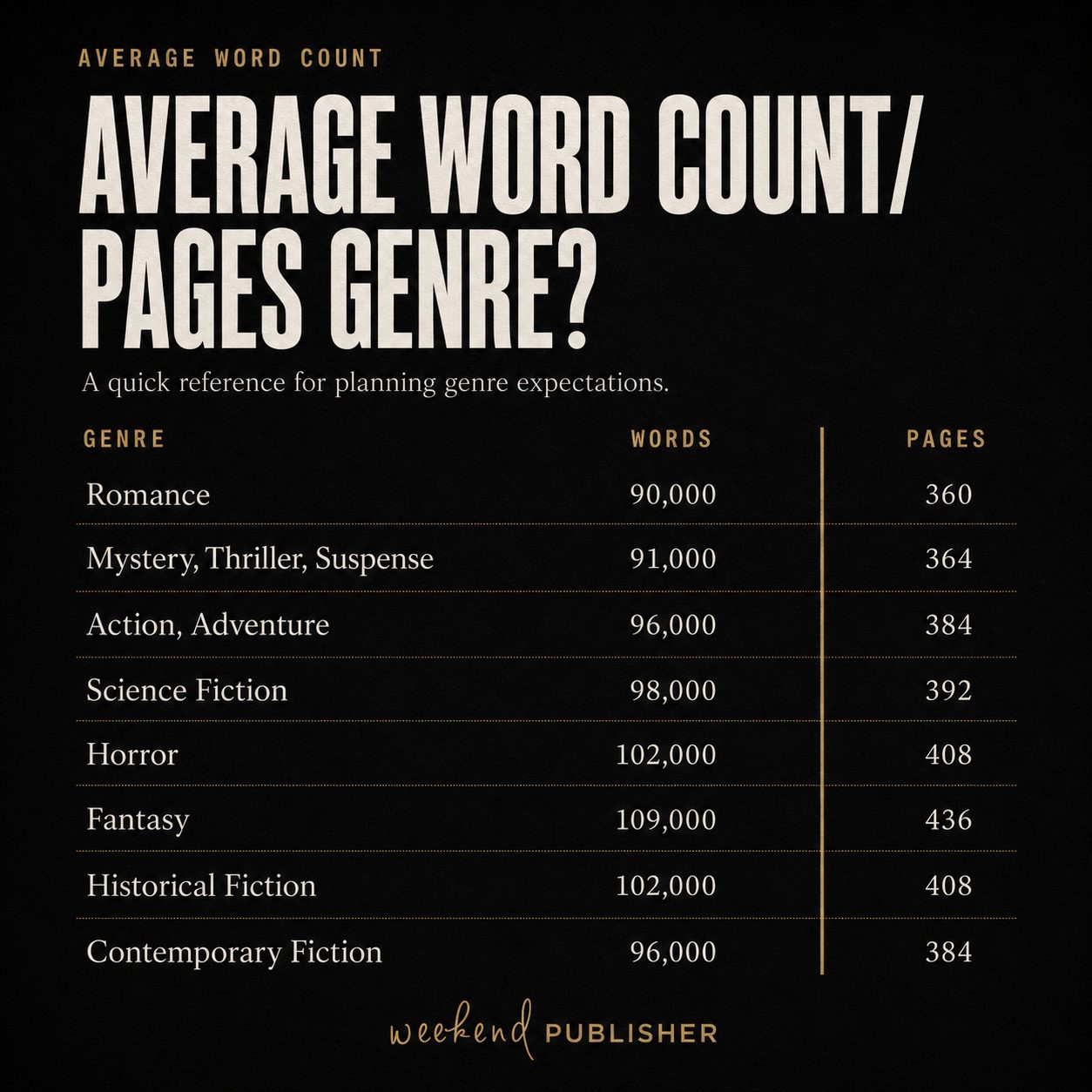
Treat these as targets, not gospel. Rushing a story to hit a number — or padding it to reach one — is a revision problem wearing a word-count costume. Write until the story is complete, then check where you landed.
How long should a fantasy or sci-fi novel be?
Since most of my work is with science fiction and fantasy authors, this is the version of the question I answer most. The data says: fantasy bestsellers average 109,000 words (~436 pages) and science fiction 98,000 words (~392 pages) — the two longest genres in commercial fiction, because worldbuilding takes room. If you want to run the same check on your own subgenre, Publisher Rocket (affiliate link) is the fastest way to see what's actually selling in any Amazon category.
For a debut, I recommend aiming at or slightly under the average: 90,000–110,000 words for fantasy, 85,000–100,000 for sci-fi. Two economic reasons. First, editing, cover-to-content fit, and production costs scale with length, and a debut is the book you're most likely to want to revise. Second, in Kindle Unlimited — where most indie SFF revenue lives — a longer book only earns more if readers finish it. Read-through is the metric that matters, and a tight 95,000-word debut that readers finish beats a sprawling 150,000-word one they abandon at 40%.
Once the manuscript is the right length, the next question is how to sell it. I compare the main options (agencies, marketplaces, promo platforms, and genre specialists) in my guide to the best book marketing service for fantasy authors, and I walk through how to run Facebook ads for sci-fi and fantasy novels step by step.
How to check your own genre’s page counts
The averages above cover the big genres. If you write in a narrower lane, cozy fantasy, LitRPG, space opera, you can pull the real numbers yourself in about five minutes with Publisher Rocket (affiliate link). Two ways I do it:
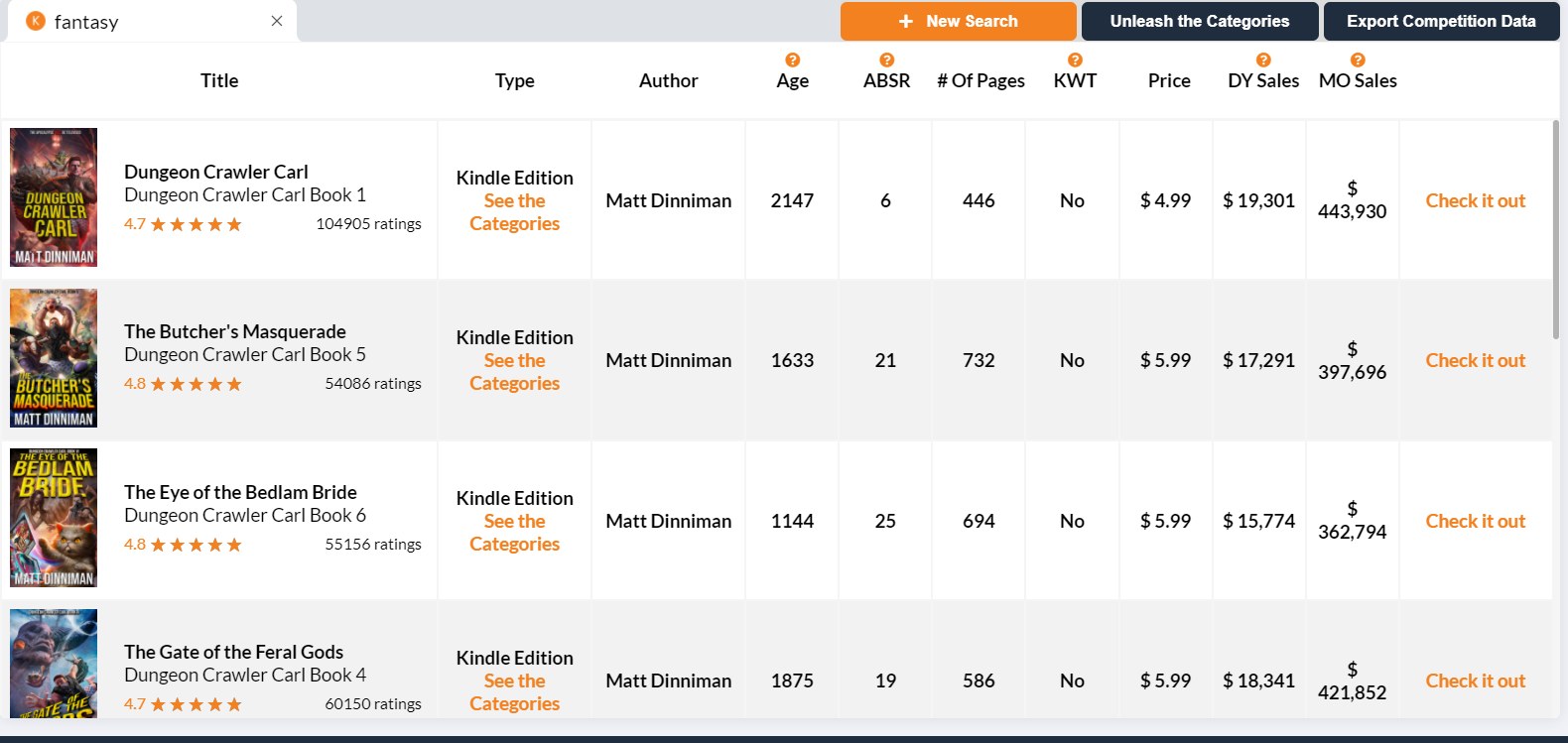
1. The Competition Analyzer. Search your genre keyword and read the # Of Pages column for the top books that come up. Multiply by roughly 250 words per page, the same conversion used throughout this article, and you know what today’s bestsellers in your lane actually run. When I search “fantasy,” the top of the list right now is Matt Dinniman’s Dungeon Crawler Carl series at 446 to 732 pages per book, call it 110,000 to 180,000 words. LitRPG readers want to live in a world for a long time, and the books earning $400,000 a month deliver exactly that.
2. The Keyword Search. The Average Pages column gives you the same read across a whole keyword at a glance. One caveat, because the number will surprise you: broad keywords like “fantasy” show averages over 1,000 pages. That is not because everyone is writing 250,000-word novels. Box sets and omnibus editions rank on those big keywords and drag the average up. Trust the individual books in the Competition Analyzer more than the broad-keyword average, or check a narrower keyword: “cozy fantasy” shows 298 average pages, roughly 75,000 words, which is exactly what that subgenre’s readers expect.
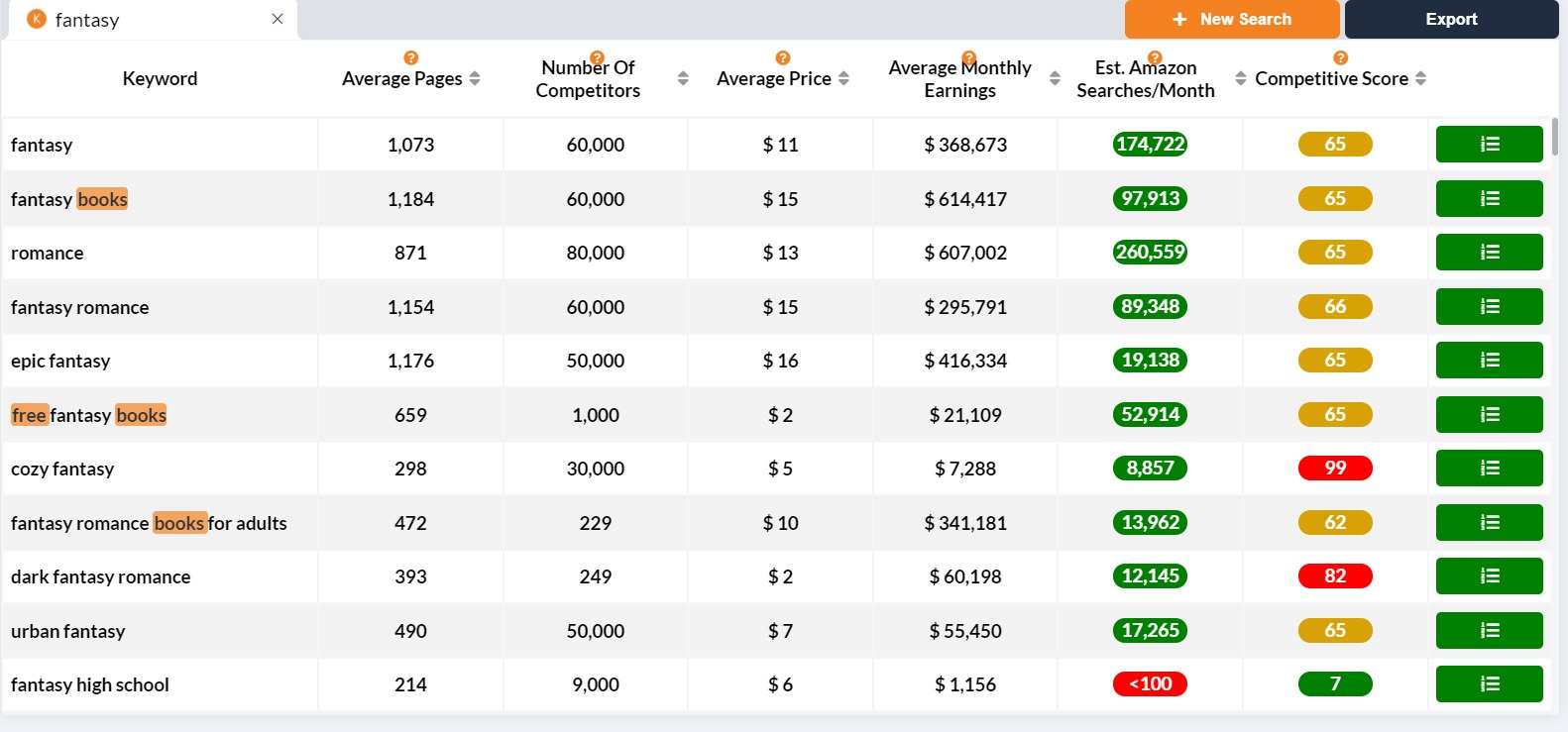
Either way, the point is the one this whole article keeps making: the right length is not a rule, it is a market. Check yours before you commit to 150,000 words.
How many pages in a chapter?
The working average is 2,000–5,000 words per chapter — about 8 to 20 pages. The extremes prove there's no law: Laurence Sterne's Tristram Shandy contains a chapter with zero words, while The Last Unicorn by Peter S. Beagle has a chapter over 23,000 words. For a first book, stay near the average. Consistent, moderate chapters create the "just one more" rhythm that keeps Kindle Unlimited readers turning pages — and in KU, pages turned are income.
How long should your first novel be?
Stick close to your genre's average — or slightly under. The pattern among famous series is striking: authors earn the right to write long.
- J.K. Rowling: Harry Potter and the Philosopher's Stone is 76,944 words — below the fantasy average. By the finale, Deathly Hallows ran 198,227 words. The series' word count more than doubled as the readership grew.
- J.R.R. Tolkien: The Hobbit is 95,356 words; The Fellowship of the Ring, published after his audience was established, is 187,790.
The logic is return on investment — the reader's, not just yours. A reader browsing an unknown author is gambling time and money, and a 150,000-word doorstopper raises the stakes of that gamble. A tighter debut lowers the barrier, earns trust, and starts your series read-through. Once readers know your name delivers, you can write as big as the story demands. Your first book is also very unlikely to be your best — better to learn the craft on a normal-sized canvas.
Frequently asked questions
How many pages is a 50,000-word book?
About 170–200 printed pages at 250–300 words per page — the minimum length generally accepted as a novel.
How many pages is a 90,000-word book?
About 300–360 printed pages. This is the length of the average commercial novel.
What is the difference between a novella and a novelette?
Word count. A novelette runs roughly 7,500–20,000 words; a novella runs roughly 20,000–50,000. The SFWA awards definitions draw the line at 17,500 words. Nobody outside awards committees polices the boundary — retailers mostly care that you don't label a novella a novel.
Can my first novel be 150,000 words?
You can publish anything you like, but the data argues against it: readers hesitate to gamble that much time on an unknown author, production costs scale with length, and even in fantasy — the longest genre — bestsellers average 109,000 words. If your draft is 150,000, that's usually a signal to revise, split into two books, or save the epic for book three, when your audience is ready to follow you anywhere.
Does page count affect how much I should charge?
It's one factor among several — novellas are usually priced below full novels, and Kindle Unlimited changes the math again because payment comes per page read rather than per sale. Pricing strategy deserves its own article; the short version is that word count sets reader expectations, and price has to match them.
Get In Touch
Write the book.
We'll handle
the numbers.
Word count is the first number in your book's life, but the ones that decide your career come later: cost per new reader, read-through rate, pages read. Weekend Publisher helps sci-fi and fantasy authors manage exactly those — through coaching or done-for-you ads management, with pricing published openly.
I typically respond within one business day.
Or email directly
[email protected]