Facebook ads for authors: the complete sci-fi and fantasy campaign guide
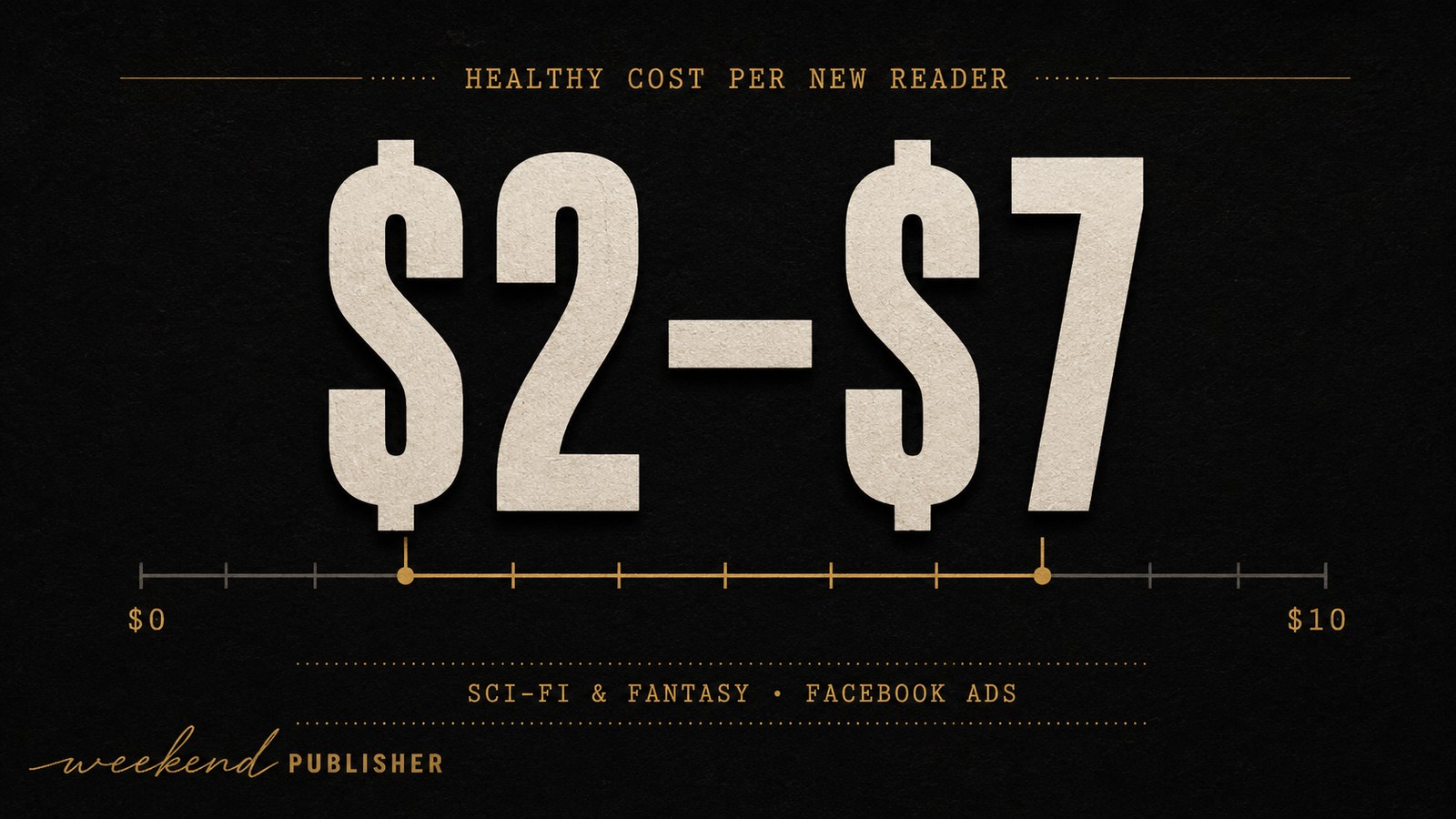
Facebook ads are the most reliable way to sell science fiction and fantasy novels consistently, and almost everything the standard advice tells you about running them is either generic or out of date. The version that actually works in 2026, based on my client data: open targeting instead of interest stacks, $10-20 a day while testing, creative that does the targeting work, and one metric, cost per new reader, that decides everything. A healthy campaign lands a new reader for $2 to $7, and profitability usually arrives around book three of a series, not book one.
Based on 16 years running Facebook ads, $225,000+ in managed ad spend, and campaign data from 350+ sci-fi and fantasy authors.
This guide covers the complete system: why generic advice fails for SFF, the targeting approach that outperforms interest stacks, campaign structures for launches versus series, budgets, creative, measurement, and documented case studies with real numbers. The writing-advice world (Jane Friedman's publishing guidance, David Gaughran's marketing books) is excellent general education, and I recommend it. But general education is exactly the problem: it has to serve romance, thrillers, memoir, and everything else at once. This is what the data says when every campaign you run is science fiction and fantasy.
Why generic Facebook ad advice fails for sci-fi and fantasy
Most Facebook ads advice for authors was developed on romance, the biggest, fastest-moving indie category, and then exported everywhere else. Romance tactics assume short books, rapid release schedules, and readers who buy several books a week. Sci-fi and fantasy break every one of those assumptions.
The books are longer and the buying cycle is slower. Bestselling fantasy averages 109,000 words and sci-fi 98,000, nearly the longest in commercial fiction. An SFF reader commits to a world, not a title, which means the economics run on series read-through and Kindle Unlimited page reads, not single-sale ROAS. An ad that "loses money" on book one while feeding readers into a five-book series is often your best performer, and generic ROAS math will tell you to kill it.
The audience isn't who the stereotype says it is. Here's a number that surprises almost every SFF author I work with: across my clients' campaigns, 70-80% of measurable engagement (ad clicks, email replies) comes from female readers. Generic advice has authors writing ad copy for an imagined audience of young male gamers; the engagement data says to lead with character, relationship, and emotional stakes, and to feature people, not just spaceships, in the creative.
Genre signaling is stricter. A romance reader forgives a vague cover; a space opera reader does not. In SFF, the subgenre promise in your ad image and hook has to match the book precisely, or you pay for clicks from readers who bounce off the sample, which is why creative, not audience settings, is where SFF campaigns are won.
None of this makes the generalist teachers wrong. It makes them incomplete. The rest of this guide is the genre-specific layer they can't provide, because they aren't inside a few hundred SFF ad accounts every week.
SFF audience targeting: why open targeting beats interest stacks
Here's the advice you'll find in most courses: build interest stacks. Target readers of Brandon Sanderson, layer in Kindle owners, add "epic fantasy" as an interest. I've tested exactly that approach against open targeting across my client accounts, repeatedly. Open targeting wins.
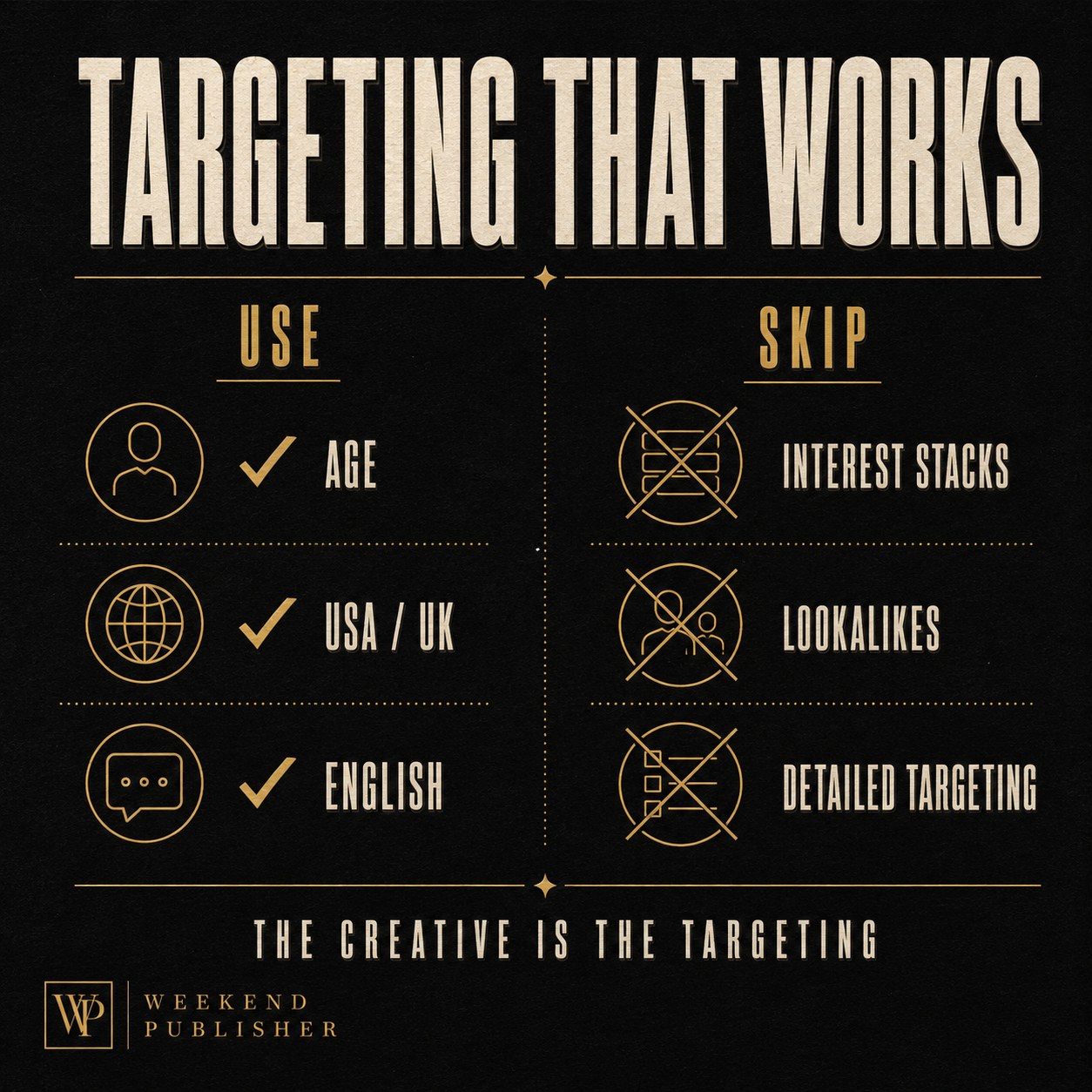
My standard cold-audience setup for a sci-fi or fantasy novel is: an age range tuned to the readership, the United States as the location (the UK works too; Canada is consistently expensive per result and I usually skip it), English as the language, and nothing else. No interests, no lookalikes, no detailed targeting. Meta's delivery system reads the ad creative, watches who engages in the first hours, and finds the audience faster and cheaper than any manually built stack. Your ad (the cover art, the hook, the comp-author anchor) is the targeting. The audience settings just set the boundaries.
I've been running Facebook ads since 2010, and the trend line is unambiguous: sixteen years ago you could target with absurd precision, and Meta has removed granularity nearly every year since. Detailed targeting categories keep shrinking while the algorithm keeps improving. If I had to bet, meaningful manual targeting won't exist at all within a few years. Building your skills around interest stacks is building on land the platform is actively reclaiming. Building around creative testing is building on the one thing Meta keeps rewarding.
There's a second reason interest stacks underperform for SFF specifically: the interest categories are crude. "Fantasy" as a Meta interest lumps Fourth Wing readers with Warhammer players; a Brandon Sanderson interest audience is full of people who watched one YouTube video. You end up paying a premium to narrow delivery toward a mislabeled audience, while open targeting lets actual click-and-buy behavior define it precisely.
Campaign structures: new release vs. series promotion
Launching a new book
The ads are the last step of a launch, not the first. The sequence I run with clients:
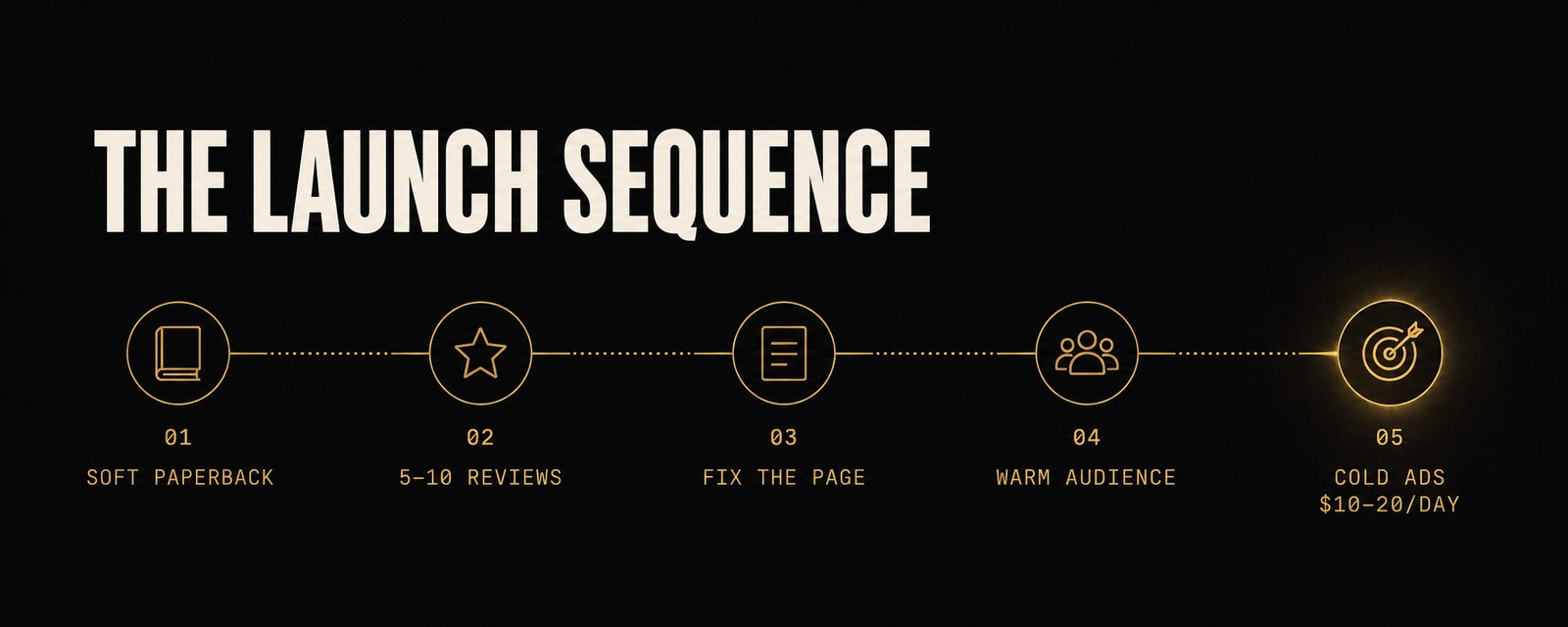
- Soft-launch the paperback first. Publishing the paperback quietly before the ebook creates a live Amazon page and a window to gather reviews without burning your Hot New Release period.
- Get 10-50 reviews before spending on cold traffic. Ten reviews is the working floor for ads to convert; more is better. Use ARC platforms and your network, legitimately. No paid reviews, no incentivized family purchases; review farming can end an Amazon account. One author in my community was testing a new review service, spotted suspicious AI-generated reviews landing on his book, and reported them to Amazon himself rather than risk his account. That's the level of caution the platform now demands.
- Fix the page before buying traffic to it. Genre-aligned cover, a blurb whose first line earns the second, categories chosen for a realistic run at #1, keywords from actual search behavior. Publisher Rocket (affiliate link) is what I use for the last two.
- Warm audiences first, then cold. Announce to your newsletter and followers first, then open the cold campaign to feed the momentum spike the algorithm rewards.
- Stack the release if you can. The single most effective launch structure I've seen: release Book 2 alongside Book 1 (or shortly after). One client, Mark Stanley, launched this way and rode read-through to $200/day in net profit within months.
Promoting an existing series
Series promotion is where SFF economics shine, and where I now point most ad budgets. Always advertise book one (readers enter worlds at the front door) but the structural plays are different:
- "Completed series" is a marketing event. Finishing a series changes the ad language: risk-averse readers who won't start an unfinished epic will binge a completed one. Update creative to say so.
- Series-page campaigns. We've been testing ads pointed at the Amazon series page (or an omnibus) rather than book one's page, using Amazon Attribution links to track it. For deep catalogs, bundles and box sets revive read-through and attract bulk buyers.
- Back matter is part of the campaign. Every book's end matter should point at the next book, the series page, and your list. Ads buy the reader once; back matter compounds them.
How I structure the account
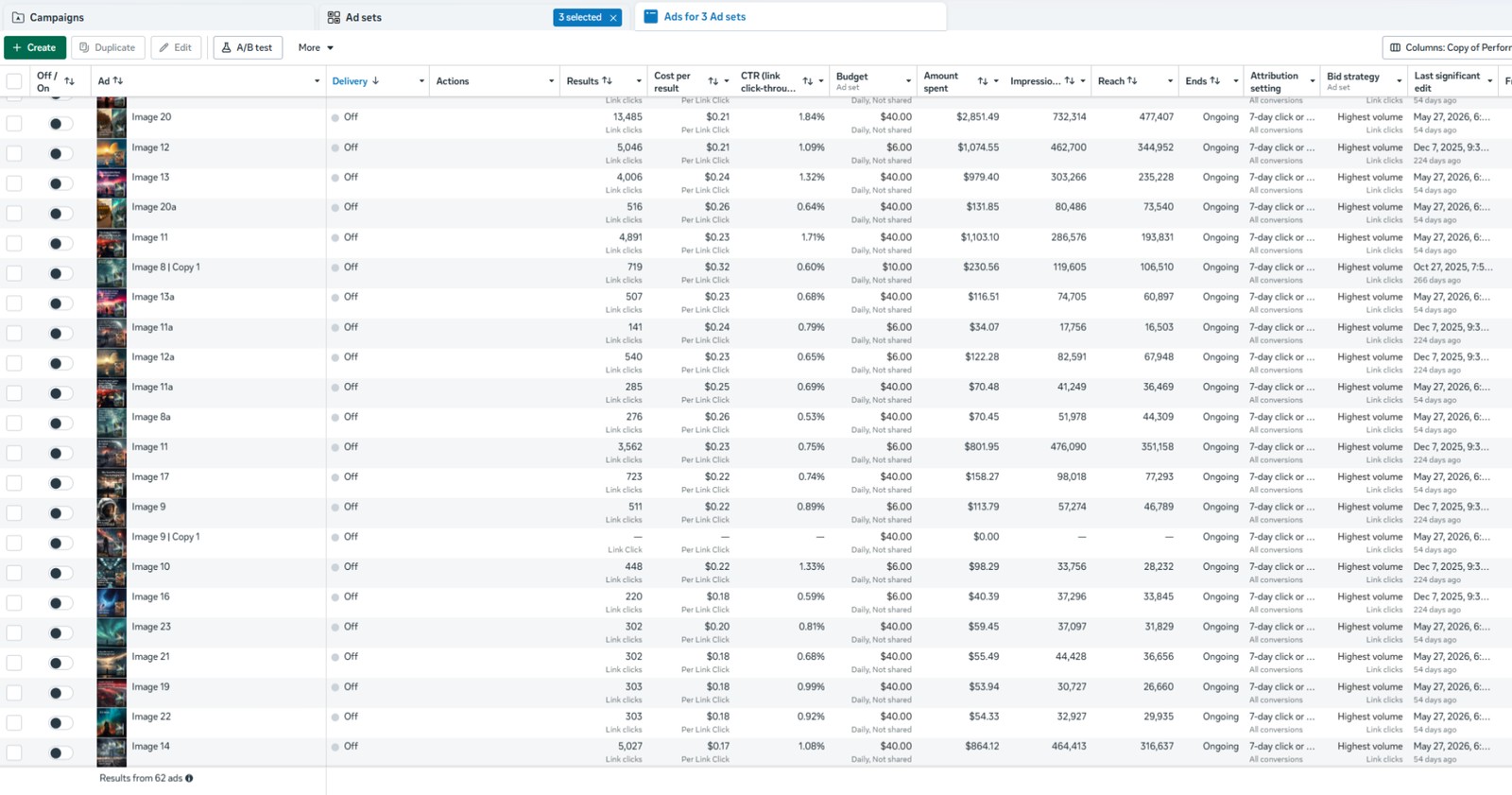
Keep it simple: one campaign per book or series goal, ad sets used sparingly, and, critically, ads separated enough that each gets clean data. When multiple ads share a set, Meta shovels budget at an early winner and starves the rest before they're proven. I had a sci-fi author whose set of five ads showed one "winner" eating 90% of the budget within days. We isolated each ad into its own set, and only then could we actually see which creative earned its spend versus which one had simply gotten lucky first. And judge nothing before roughly 200 clicks; below that, you're reading noise. Some ads work, some don't, and that's normal. We're testing, not gambling.
Your first campaign, step by step
For the author who has never opened Ads Manager, here is the complete setup, in order. Budget three to ten hours for the initial build depending on where you're starting from; after that, the maintenance load is about an hour a week.
- Set up the plumbing first. A Facebook business page for your author brand (required to run ads), a Meta Business/Ads Manager account with a working payment method, and Amazon Attribution links for every ad you'll run. Attribution is non-negotiable: Amazon won't let you put a tracking pixel on your book page, so attribution links are the only way clicks ever connect to sales.
- Create one campaign for book one of your series. Because you can't pixel Amazon, most SFF campaigns optimize for link clicks/traffic and are judged on downstream attribution and royalty data rather than Meta's in-platform conversion numbers. Meta will nudge you toward Advantage+ everything; that's fine. The settings that matter are the ones you'll restrict, not the ones you'll add.
- Set the audience: age range, United States, English. Stop there. No interests, no lookalikes. If your books also sell in the UK store, add the UK as a second test later. Never mix countries in one ad set, or the cheap market eats the budget.
- Load three to five ads. Same book, different angles: one with the cover on a warm scene with characters, one plain text-hook "ugly ad," one comp-author anchor ("For readers of..."), and one wildcard you don't believe in. The one you don't believe in wins often enough to keep you humble.
- Set $10-20/day and don't touch anything for a week. Early fiddling resets Meta's learning phase and burns your test budget twice.
- Review weekly, judge at ~200 clicks. Pause clear losers, leave winners alone, add one new challenger at a time, and log everything (spend, clicks, attributed sales, page reads) somewhere you can see trends, not days.
Tell me what you've got: your targeting, your budget, and what you're seeing after a week. I'll tell you what I'd change before you spend more.
Budget: what to spend, when to scale, when to stop
Start at $10-20 per day. That's enough for Meta to learn and for you to hit meaningful click counts within weeks, without lighting a month's royalties on fire while you find your working creative. Resist the urge to start bigger: budget doesn't fix creative, and a losing ad loses faster at $50/day. (For how ad spend fits alongside services, agencies, and promos, see real 2026 book marketing cost benchmarks.)
If you're weighing whether to run this yourself or pay someone, I've broken down how much it costs to hire a book marketer, freelancer through agency, and the five questions to ask before you hand anyone money.
From there, the budget follows the data, reviewed weekly: when cost per new reader is inside the healthy range and read-through is holding, scale gradually. Big jumps reset the algorithm's learning. Real accounts I manage run the whole spectrum: an epic fantasy series scaling at $39/day, established series maintaining momentum around $600/month, and a literary campaign at $1,500/month that I told the author to pause, because the numbers said the problem wasn't the ads (more on that case below).
The profit threshold to plan around: one or two books makes the math hard, and profitability tends to kick in around the three-book mark. That's not a rule (I've seen a single book turn profits and a fifty-book catalog lose money) but it's what the aggregate says. Before book three, run ads at the testing floor and treat spend as buying three assets: your reader base, your ad data, and your next launch's momentum. That budget isn't failing to profit; it's building the machine that will.
Ad creative for SFF: what the testing actually shows
Since creative does the targeting under open delivery, this is where campaigns are won. Findings from continuous testing across my client accounts:
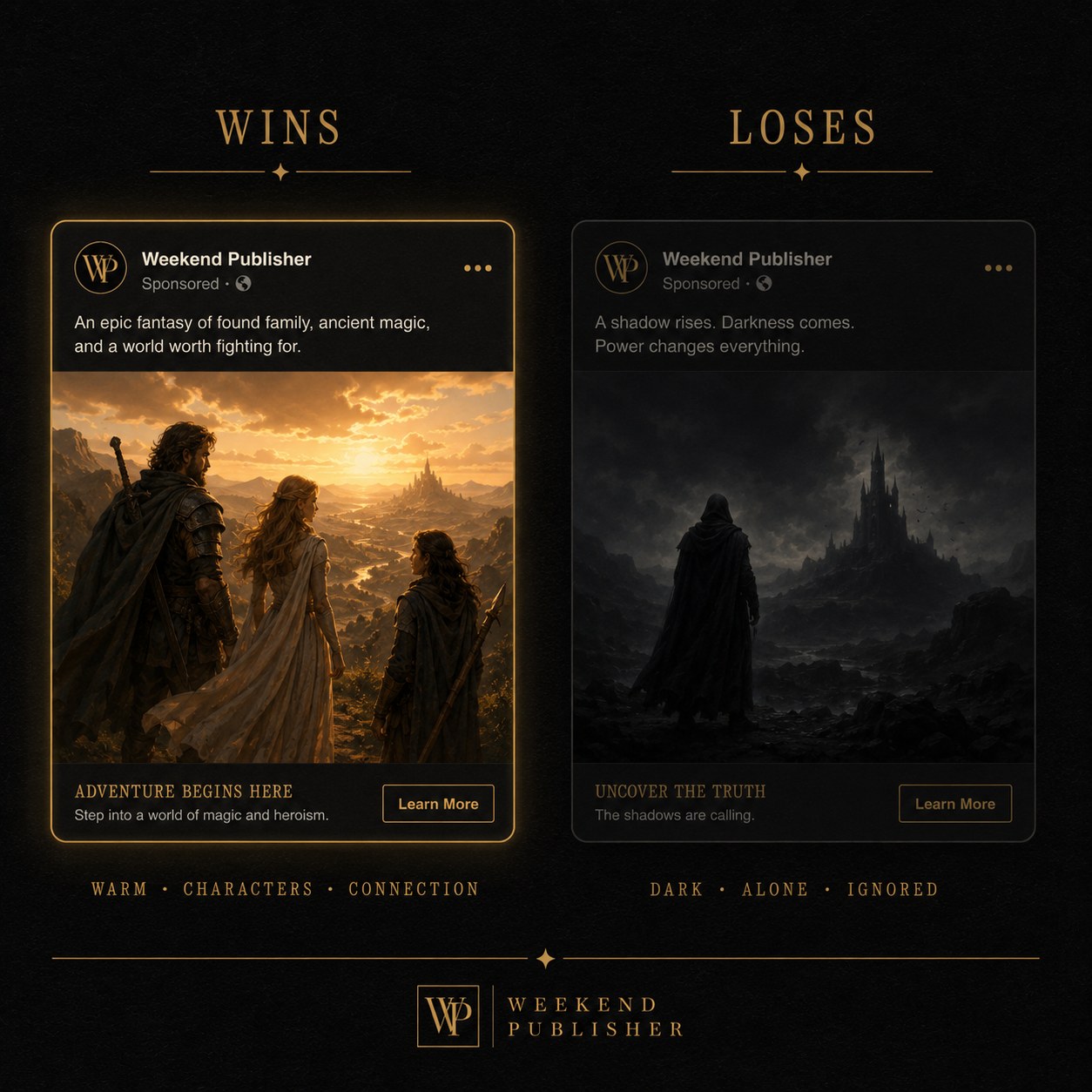
- Warm-toned images with multiple characters outperform dark, single-figure images. This one is consistent and counterintuitive. SFF authors love a brooding lone silhouette on a black field, and the data keeps punishing it. I worked with a steampunk author whose entire ad set was moody and dark, exactly matching her books' atmosphere; we rebuilt the same scenes lit at dawn and golden hour, and the brighter versions became the test set her winners came from. Warmth and human connection stop the scroll; another dark fantasy rectangle doesn't.
- Anchor against comp authors in the hook. "For readers of X" keeps winning our headline tests. Recent examples that performed include anchors to Rebecca Yarros for romantasy-adjacent fantasy and Robin Hobb and Tolkien-flavored hooks for epic fantasy. Pick comps by audience, not by which author you'd rather be compared to.
- Lead with emotion, not lore. Given that 70-80% of engagement comes from female readers, hooks about found family, loyalty, loss, and impossible choices convert; hooks about magic-system mechanics and galactic political history don't. The worldbuilding sells the fifth book, not the click.
- The cover belongs in the ad, and sometimes "ugly" wins. Show the actual cover so the Amazon page confirms the promise. Then test against your instincts: polished art, plain text-on-background "ugly ads," UGC-style shots. Clients are regularly surprised by which one wins. That's the point of testing.
- Video is a format test, not a requirement. Simple motion (drifting mist over cover art, a page-turn) can earn cheap attention, and we test it like everything else. But static images with the right hook still win constantly. Don't let "I can't make video" delay your first campaign by a single day.
Iteration rhythm: three to five creatives live, judge at ~200 clicks, kill losers, feed winners, and add one new challenger at a time. AI image tools have made creative testing dramatically cheaper (we generate and refine ad variations in-session with clients now) but the judge is always the data, never taste.
Measuring success: cost per new reader, not ROAS
I track two numbers above everything: cost per new reader and value per new reader. A healthy cost per new reader runs $2 to $7 depending on genre, price point, and how developed the series is. When the value of a reader across your whole catalog exceeds what you paid to get them, you scale. When it doesn't, you don't touch the budget. You find where the funnel leaks: cover, blurb, ad creative, or series structure, in that order of suspicion. The full definitions, formulas, and a worked example are in cost per new reader vs value per new reader.
The math, worked through
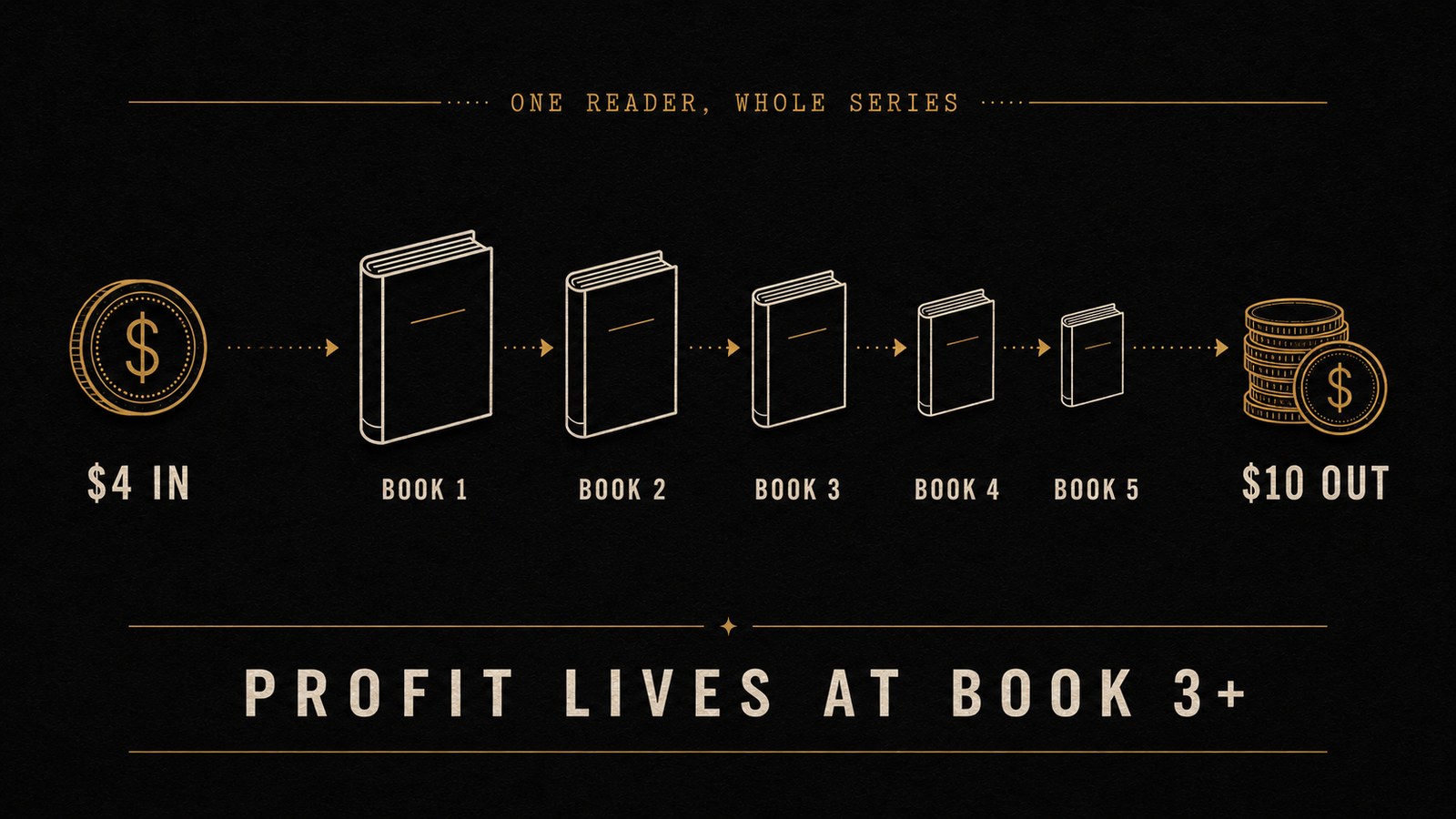
Say you write a five-book space opera in Kindle Unlimited, book one at $4.99, call it $3.40 in royalty equivalent per full read, blending sales and page reads. If 60% of book-one readers continue to book two and 80% of those keep going deeper into the series, each new book-one reader is worth roughly $3.40 now plus $6-9 more across the rest of the series, call it $10 of lifetime value. At a $4 cost per new reader, you're building a machine that pays $10 for every $4 you feed it. At one book, that same $4 buys $3.40, which is exactly why single-book ROAS looks like failure and why the three-book mark keeps showing up in the data. (Numbers illustrative; the structure of the math is the point. Your read-through rates are the levers.)
Why not ROAS? Because for series fiction, platform-reported ROAS is fiction. Kindle Unlimited page reads, often the majority of SFF revenue, never appear in Meta's conversion data. "Ghost sales" happen constantly: a reader sees your ad, doesn't click, and buys on their Kindle that night, invisible to the pixel. I sat with an author comparing his dashboards side by side. His KDP sales were spiking in ways his attribution links couldn't explain, until we mapped the spikes against ad impressions and watched the pattern snap into place: the ads were selling books to people who never clicked them. And read-through revenue arrives weeks after the click that caused it. Judge a campaign on day-one ROAS and you will kill your best ads with mathematical confidence.
The working toolkit: Amazon Attribution links on every campaign so clicks connect to store activity, KDP sales and KU page-read data pulled alongside ad data, and read-through rate tracked between every book in the series. My coaching clients get custom software that merges ad spend, attribution, royalties, and page reads into one dashboard: you open it and you know. But the stack matters less than the discipline: weekly reviews, one metric that decides (cost vs. value per new reader), and no decisions on gut feel.
One diagnostic rule worth the whole section: read-through failure masquerades as ad failure. If book one converts clicks but the series isn't profitable, check read-through before touching the ads. Below roughly 40-50% from book one to two, more traffic just scales the leak.
Where Amazon ads fit (and where they don't)
This is a Facebook ads guide because Facebook is the main driver: it finds readers who have never heard of you and delivers them at the lowest cost per new reader. Amazon ads play a real but supporting role, and knowing the difference saves a lot of budget.
Amazon ads work inside the store. They capture readers already browsing your subgenre and defend your book's placement on comparable titles' pages. But in my accounts they almost always cost more per new reader than Facebook, because you're bidding against every other author for the same shelf space instead of interrupting a scroll with something new. I use them in two situations: as an always-on layer once a series is profitable, harvesting demand the Facebook ads created; and as a diagnostic tool, because Amazon ad data shows which keywords, comp titles, and categories actually convert for your book, which is intelligence that feeds back into Facebook creative and metadata. In the literary case below, Amazon ads were precisely the right move, not to scale, but to gather data cheaply while we diagnosed a deeper problem.
Case studies from client campaigns
Epic fantasy: from a $60 monthly loss to $779 monthly profit
Andy, a seasoned fantasy author with a dragon-rider series, was spending $218/month on ads and losing $60. We rebuilt the whole funnel: moved the series into Kindle Unlimited, repriced book one from permafree to $2.99, replaced the ad creative with genre-aligned images that tested above industry-average conversion, and tracked every campaign weekly. Four months later: $553 in ad spend, 660 sales, $1,332 revenue, a $779 monthly profit, and the same playbook applied to his second series drove a 2,500%+ page-read increase in four months.
Debut series: to $200/day net profit in months
Mark Stanley launched his first fantasy book in July 2024 with a stacked release (Book 2 the same day, Book 3 soon after) plus editorial reviews for credibility and weekly budget reallocation toward whatever the data said was working. Kindle Unlimited became the primary revenue stream, and within months he averaged $200/day net.
Epic fantasy, mid-campaign: $3 per new reader while scaling
A traditionally structured epic fantasy launch I currently manage shows what "healthy and scaling" looks like from the inside: Facebook ads produced 165 attributed sales in two months at roughly $3 per new reader, comfortably inside the $2-7 healthy range, while we scaled daily spend to $39/day and kept testing headlines (the Robin Hobb and Tolkien-anchored hooks came from this account). Alongside the ads: back matter updated with calls to action for book two, a pre-order window timed to the momentum, and email list growth feeding the next launch. No single spectacular number, just the compounding system working as designed.
The honest one: when I tell a client to pause Facebook ads
A literary/climate-fiction author was spending ~$1,500/month on Facebook ads that generated real orders, and an 11% read-through from book one to two. The ads weren't the problem; the leak was downstream. My recommendation was to pause Facebook entirely, run cheap Amazon ads for data while we diagnosed the read-through, and revisit in two months. I include this case deliberately: a marketer who never tells you to stop spending isn't reading your data. Facebook ads amplify what's working. They can't fix what isn't.
Sub-genre nuance: space opera, hard sci-fi, paranormal, LitRPG
The mechanics above hold across SFF; what changes by subgenre is the promise your creative makes and the economics underneath it:
- Space opera behaves most like epic fantasy: character-ensemble creative, found-family and crew-loyalty hooks, strong KU read-through. The reachable Facebook audience is big.
- Hard sci-fi is a narrower, idea-driven readership. Comp anchors (Andy Weir, Project Hail Mary-style hooks) matter more than emotional tropes, and cost per new reader tends toward the top of the healthy range. Plan for $5-7, not $2.
- Paranormal and urban fantasy sit closest to romance mechanics: fast read-through, heavy KU, and creative where the character (and often the romance thread) leads. The 70-80% female engagement number is at its strongest here.
- LitRPG and progression fantasy have the most voracious readers in KU: long books, fast consumption, deep series. The audience is niche on Facebook, which makes creative signaling (interface boxes, level-up language in the hook) do all the work of finding them under open targeting.
Notice what's not in that list: different targeting settings. The audience setup is identical in every case. The creative carries the subgenre.
The six mistakes that burn SFF ad budgets
- Judging ads before 200 clicks. Small samples produce confident nonsense. The ad that "failed" at 40 clicks was never tested; it was polled.
- Advertising a book page that can't convert. Fewer than ten reviews, an off-genre cover, or a blurb that buries the hook will make every ad look broken. Traffic exposes the page; it doesn't fix it.
- Scaling on a broken read-through. If book one to book two is leaking, more spend means a bigger leak. Fix the funnel, then buy the traffic.
- Chasing cheap clicks in cheap countries. Worldwide targeting produces beautiful CPC numbers and no book sales. You're buying readers in the stores where readers buy.
- Panicking at single-book economics. Doing the math on one book's royalties against the whole ad budget, then quitting: the most common exit ramp, and the one the "you're buying a reader" reframe exists to prevent.
- Set-and-forget in either direction. Daily fiddling resets the algorithm; monthly neglect misses creative fatigue. Weekly is the rhythm. About an hour, with the right dashboard.
Tell me what you've got: your targeting, your budget, and what you're seeing after a week. I'll tell you what I'd change before you spend more.
Weekend Publisher vs. Written Word Media vs. DIY
| Weekend Publisher | Written Word Media | DIY Facebook ads | |
|---|---|---|---|
| What it is | SFF-only ads management or coaching | Email promo blasts (Freebooksy, Bargain Booksy) | You run everything yourself |
| Best for | Series authors building consistent daily sales | Short-term spikes for discounted/free books | Authors with time to learn and test |
| Cost | Coaching $2,497 (6 months); done-for-you from $4,000 | $25-$499+ per promo | $300-600/mo ad spend + your hours |
| Timeline | Compounding: 2-4 weeks to working creative, then ongoing | One spike per promo, days-long effect | 3-6 months learning curve is typical |
| Measurement | Cost/value per new reader, attribution, read-through | Downloads during promo window | Whatever you build yourself |
These aren't rivals so much as different jobs: I use Written Word Media promos inside client campaigns for launch spikes, and DIY is exactly what my coaching teaches. The comparison is really "spike vs. system vs. sweat equity." For how a genre specialist stacks up against full-service agencies and freelance marketplaces, see my comparison of the best book marketing services for fantasy authors.
Frequently asked questions
How much budget do I need to launch a sci-fi debut with Facebook ads?
Plan on $10-20/day for the first 60-90 days (roughly $300-600/month) treated as tuition for your ad data, your reader base, and your creative testing, not as immediate profit. A debut with no series behind it rarely pays back its own marketing, and shouldn't be expected to. The spend is building the foundation book three cashes in.
Do interest stacks like "Brandon Sanderson readers" work for book ads?
In my testing across hundreds of SFF campaigns: no. Open targeting (age, country, language, nothing else) consistently beats detailed interest targeting, because Meta's delivery system reads your creative and finds buyers more precisely than its own crude interest categories. Meta has also been steadily removing targeting granularity since 2010, so systems built on interest stacks age badly.
When should I run ads versus focusing on newsletter growth?
They're not rivals; ads are how modern newsletters grow. Run ads once your book page can convert cold traffic (10+ reviews, genre-aligned cover, strong blurb), and make sure back matter and reader magnets convert those paid readers onto your list. One client's targeted ads grew email signups 510%. Newsletter-only growth works; it's just slow, and it borrows someone else's audience instead of building the skill of buying your own.
Do Facebook ads work for hard sci-fi, or just space opera and fantasy?
They work across SFF. The setup doesn't change, but expectations should. Hard sci-fi's smaller, idea-driven audience typically means cost per new reader at the top of the healthy $2-7 range, and comp-author anchoring in the hook matters more than emotional tropes. Space opera and paranormal behave like the bigger genres they border and usually land cheaper.
Should I advertise in Canada or other countries?
My standard is the United States, with the UK as a solid second market. Canada consistently costs more per result in my accounts, so I usually skip it. Adding low-cost countries to inflate cheap clicks is a vanity move: you're buying readers, and readers who buy books live disproportionately in the US and UK stores.
How long until my ads are profitable?
Expect the first two to four weeks to be pure testing, finding the creative that earns clicks at a sane cost. From there the timeline depends on your catalog: a three-plus-book series with healthy read-through can reach monthly profitability in a quarter (Andy's turnaround took four months from first fix to $779/month profit); a standalone debut usually shouldn't expect ad-level profitability until the series behind it exists. What compounds in the meantime is real: ad data, reader base, list growth, and launch momentum for the next book.
Should book one be free (permafree) if I'm running ads?
Usually not anymore. Permafree made sense when free downloads reliably converted into series readers; in my client data, a $0.99-$2.99 book one filters for readers who actually read what they download and pays part of your ad bill on entry. Repricing Andy's book one from free to $2.99 was one of the levers that flipped his catalog from loss to profit. Free still has a place as a limited-time promo spike layered under ads, not as a permanent front door.
When should I stop or pause my ads?
When the funnel under them is broken. If cost per new reader sits above your value per new reader after fixing creative, or read-through from book one to two is under roughly 40%, pause and repair (cover, blurb, pricing, series structure) then relaunch. Ads scale what exists. Pausing is sometimes the most profitable move available, and a marketer should be willing to tell you so.
Get In Touch
Run ads like
a system, not
a slot machine.
Open targeting, creative testing, weekly data reviews, and cost per new reader as the deciding vote. If you want it done with you, The Readership Engine is $2,497 for six months of group coaching. If you want it done for you, ads management starts at $4,000. Either way, the first step is a value call where we look at your actual numbers and I tell you honestly what I'd do, including, sometimes, "don't run ads yet."
I typically respond within one business day.
Or email directly
[email protected]